

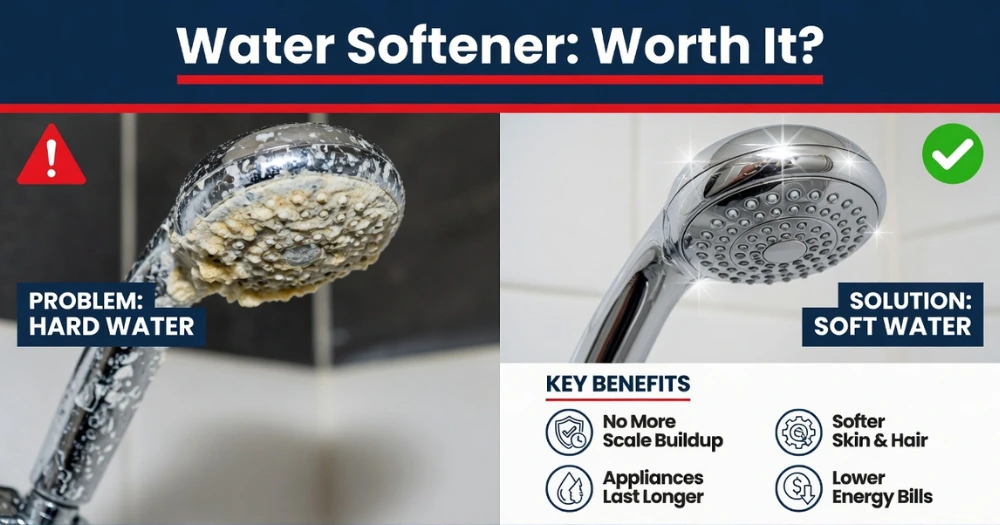
If you’ve got white crust on your shower head, spotty glasses no matter how well you rinse them, or skin that feels tight after every shower, hard water is probably the culprit. A water softener is the usual fix, but it’s not automatically the right call for every home.
Here’s an honest look at the pros and cons of a water softener, what it actually costs installed, and how to tell if your New Jersey home needs one.
What a Water Softener Actually Does
Hard water carries dissolved calcium and magnesium. A water softener runs that water through a tank of resin beads that swap those minerals for sodium (or potassium) ions. What comes out the other end is “soft,” meaning no scale forming minerals left behind.
That’s the whole mechanism. Everything else in this article is really about whether that trade off is worth it for your specific house.
The Pros of a Water Softener
Less scale on fixtures and in pipes. This is the headline benefit. Softened water won’t leave the chalky white buildup you see on faucets, shower doors, and coffee makers.
Appliances last longer. Scale buildup inside a water heater, dishwasher, or washing machine makes them work harder and fail sooner. Softened water reduces that internal wear.
Soap and detergent go further. Hard water reacts with soap to form a film instead of lather, which is why you use more shampoo and dish soap than you probably need to. Soft water lathers properly, so you use less of both.
Skin, hair, and laundry feel different. Many people notice softer skin, better rinsing hair, and laundry that comes out less stiff once hard water minerals are out of the mix.
Lower long term energy costs. A water heater with a scaled up tank or heating element loses efficiency. Cutting scale buildup helps the unit run closer to its rated efficiency.
The Cons of a Water Softener
Real upfront and ongoing cost. Installed systems typically run $1,200 to $3,800 depending on capacity and type, and you’ll be buying salt (or potassium) refills for the life of the unit.
Added sodium in your water. This worries people more than it probably should, but it’s a legitimate consideration if you’re on a strict low sodium diet.
Salt brine discharge. Traditional softeners flush a small amount of salty wastewater during regeneration cycles, which isn’t ideal for septic systems or the environment. Salt free alternatives exist but don’t remove hardness minerals the same way; they just reduce scale formation.
Takes up space. You’ll need room for the tank (and brine tank, for salt based systems) near your main water line, usually in a basement or utility closet.
Not always necessary. If your water is only mildly hard, a softener may be more system than you need.
How Do You Know If Your Water Is Actually Hard?
Hardness is measured in mg/L (also written as ppm) or grains per gallon, based on how much dissolved calcium and magnesium your water carries. According to the USGS, the standard scale breaks down like this:
| Hardness Level | mg/L (ppm) |
|---|---|
| Soft | 0 to 60 |
| Moderately hard | 61 to 120 |
| Hard | 121 to 180 |
| Very hard | 180+ |
Most water utilities publish this number in their annual water quality report, or you can test it yourself with a cheap hardness test strip. Well water tends to run harder than municipal water, but it varies by region and even by neighborhood.
Hardness varies a lot by location, even within the same state, one town can test “moderately hard” while a town twenty minutes away tests “very hard.” If you’re in our New Jersey service area, our water heater FAQ page has hardness numbers for several local towns, along with more on how hard water affects tank versus tankless units specifically.
What About the Sodium?
This is the most common hesitation people have, and it’s mostly overblown. According to the Mayo Clinic, an 8 ounce glass of softened water typically contains under 12.5 milligrams of sodium, well within the FDA’s “very low sodium” category. For comparison, a slice of bread has more sodium than that.
If you’re on a medically prescribed low sodium diet, it’s still worth a quick conversation with your doctor, and a bypass tap for cold drinking water or a reverse osmosis add on can sidestep the issue entirely.
Does a Water Softener Protect Your Water Heater?
Yes, and this is the part that matters most to us. Hard water minerals settle at the bottom of a tank water heater and coat the heating elements in tankless units, forcing the system to work harder and fail sooner. We’ve written more on this in our guide to how hard water affects water heaters in New Jersey, and covered maintenance steps that help either way in our guide to maximizing water heater lifespan.
A quick honest note from experience: a softener helps, but it doesn’t replace annual maintenance. We’ve serviced plenty of water heaters in softened water homes that still had sediment buildup, usually because the softener wasn’t sized right for the household or the maintenance schedule slipped. A softener reduces the problem, it doesn’t eliminate the need for a yearly flush.
Is It Worth It for Your Home?
A water softener is probably worth it if:
- Your water tests hard or very hard (120+ ppm)
- You’ve noticed scale on fixtures, filmy dishes, or a water heater failing earlier than its expected lifespan
- You’re planning to keep the home long enough for appliance lifespan savings to offset the cost
It’s probably not worth it if:
- Your water tests soft to moderately hard
- You’re on a strict sodium restricted diet and don’t want to add a bypass system
- You’re only in the home short term and won’t recoup the cost
FAQ
How long does a water softener last?
Most quality systems last 10 to 15 years with regular salt refills and occasional resin bed maintenance.
Will a water softener fix low water pressure?
No, a correctly sized softener shouldn’t noticeably affect pressure. If pressure drops after installation, the unit is likely undersized or something’s wrong with the install.
Does Doctor Water Heater install water softeners?
Our focus is water heaters, boilers, and general plumbing across Morris, Bergen, Essex, and Passaic counties. If hard water is shortening your water heater’s lifespan or causing repeat sediment buildup, contact us for an inspection, we’ll tell you honestly whether the water heater, the water softener, or both need attention.
Can I just flush my water heater instead of installing a softener?
For mildly hard water, annual flushing alone may be enough. For hard or very hard water, flushing helps but a softener addresses the root cause across every fixture and appliance in the house, not just the tank.
Source
- USGS Water Science School — Hardness of Water


