
Running low on hot water partway through a shower is annoying enough that most people will try anything to fix it. The obvious move is cranking the thermostat up. It works, but it also comes with tradeoffs most homeowners never hear about until something goes wrong.
A hot water mixing valve solves the same problem more safely. Here’s how it works, why it beats simply turning up the heat, and what to know before installing one.
What Is a Water Heater Mixing Valve?
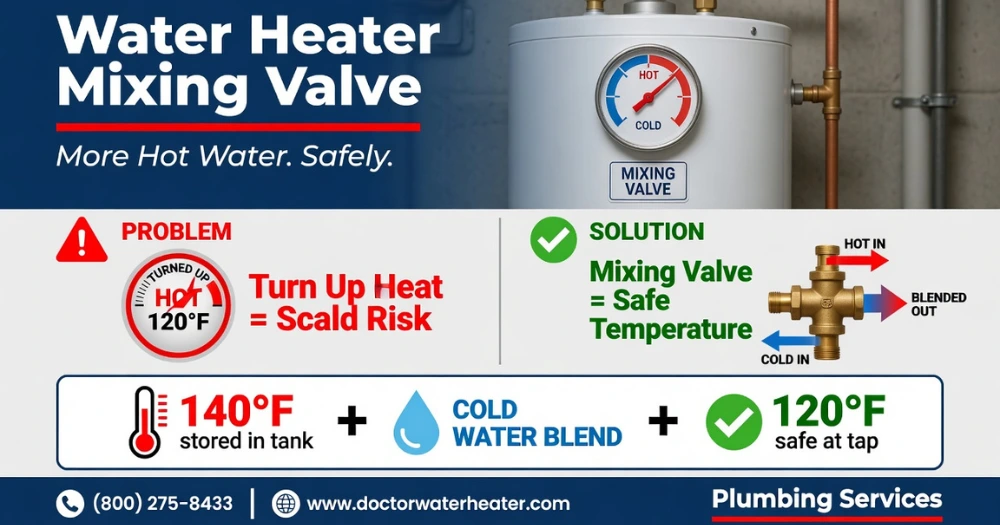
A water heater mixing valve (also called a thermostatic mixing valve, or TMV) blends hot water from the tank with cold water before it reaches your faucets and showers. Instead of drawing straight from a tank set to your everyday comfort temperature, the valve lets the tank run hotter, then tempers it down to a safe delivery temperature on the way out.
The idea is simple: hotter water stored in the tank stretches further, since it takes less of it, mixed with cold, to fill the same shower or bathtub. You end up with more usable hot water from the same size tank.
Why Not Just Turn Up the Thermostat?
Cranking the thermostat without a mixing valve does technically give you more hot water. It also creates three problems.
Faster tank wear. Hotter stored water speeds up corrosion inside the tank, which means checking and replacing the anode rod more often, more frequent sediment flushing, and, on electric models, quicker heating element failure.
Lower efficiency. A hotter tank loses more heat to its surroundings between uses (called standby loss), and takes longer to recover after a big draw. Both push your energy bill up.
Real scald risk. This is the one that matters most. According to the U.S. Consumer Product Safety Commission, water at 120°F takes about 5 minutes of contact to cause a third-degree burn. At 130°F that drops to 30 seconds. At 140°F, it’s about 6 seconds. At 150°F, roughly 2 seconds.
|
Water temperature |
Time to third-degree burn |
|
120°F |
About 5 minutes |
|
130°F |
About 30 seconds |
|
140°F |
About 6 seconds |
|
150°F |
About 2 seconds |
That’s a steep curve. Going from 120°F to 140°F doesn’t just make water “a bit hotter,” it cuts the safety margin from minutes to single-digit seconds.
How a Mixing Valve Fixes This
A mixing valve lets you get the benefit of a hotter tank (140°F, for example) without exposing anyone in the house to 140°F water at the tap. The valve automatically blends in cold water so what comes out the other end lands at whatever safe temperature you’ve set, typically 120°F.
Because it takes less of the hot, high-temperature water to produce a gallon of usable 120°F water, your effective hot water supply stretches noticeably further, without changing the size of the tank or your energy source.
Where to Install One
There are two main approaches:
At the water heater outlet. One valve installed right where hot water leaves the tank tempers everything supplied to the house. This is the more common whole-home setup and is what most residential installations use.
At individual fixtures. A smaller valve at a specific sink or shower can temper water just for that location, useful in situations like a shared bathroom used by young children or older adults where extra scald protection matters most.
Valves installed at the hot water source are commonly rated to ASSE 1017, the industry performance standard for temperature-actuated mixing valves used in residential hot water distribution.
What It Costs, and Why a Pro Should Handle It
A mixing valve itself is a relatively inexpensive part. The installation is where it gets particular: the valve needs to be correctly calibrated for your specific setup, and getting that wrong defeats the purpose entirely.
We’ve mentioned mixing valve issues before in our guide on water heater noise, where a failing or improperly set valve is a common cause of weak flow or unusual sounds. That’s not a coincidence. A mixing valve is a mechanical device with moving parts, and it needs to be set up right the first time.
Maintenance and Lifespan
Mixing valves need periodic cleaning to keep functioning properly, particularly if you have hard water. Mineral buildup inside the valve is the most common reason they eventually fail.
Expect a working lifespan somewhere between 5 and 15 years depending on water quality and how well the valve is maintained. Hard water shortens that considerably; soft water and regular cleaning stretch it toward the higher end.
Here’s the part that catches people off guard: mixing valves tend to fail gradually, not all at once. As internal components wear, the valve slowly allows more hot water through than it’s set for. Because the change happens over weeks or months, it’s easy not to notice until someone gets an uncomfortably hot surprise in the shower. It’s worth testing your water temperature by hand periodically, especially if the valve has been in place for several years.
A Note From Experience
We’ve been called out more than once to a home where someone assumed a mixing valve was the problem when it was actually a sediment-clogged dip tube doing the same thing (letting more hot water through than expected). The symptoms can look identical from the homeowner’s side. If your water temperature seems off, it’s worth having someone actually test the valve rather than assuming, since replacing a working valve doesn’t fix an unrelated issue.
FAQ
Is a mixing valve the same as a tempering valve?
Functionally, yes, though “tempering valve” is sometimes used for simpler, non-thermostatic versions. A true thermostatic mixing valve actively adjusts to maintain a set output temperature even if incoming water temperature or pressure shifts.
Can I install a mixing valve myself?
It’s possible, but calibration matters. A valve that’s set incorrectly can deliver water that’s hotter than intended, which defeats the entire purpose of installing one. Most homeowners have this done by a licensed plumber.
Will a mixing valve fix low water pressure?
Not directly. If you’re seeing weak flow along with temperature issues, that combination often points to sediment or a separate valve problem rather than the mixing valve itself.
Does a mixing valve replace the need to flush my water heater?
No. A mixing valve manages temperature at the outlet. Sediment still builds up inside the tank regardless of whether a mixing valve is installed, so annual flushing is still worth doing.
If your hot water runs out fast, feels inconsistent, or you’re considering raising your thermostat setting, contact us and we’ll walk you through whether a mixing valve makes sense for your setup.
Sources
- U.S. Consumer Product Safety Commission: Avoiding Tap Water Scalds
- PHCP Pros: The ASSE 1070 Standard