
A dishwasher that won’t drain, won’t start, or leaves your glasses cloudy is annoying, but it’s rarely a reason to panic. Most problems trace back to one of three things: a clogged filter, a blocked hose, or water that isn’t hot enough to do the job.
Run through the checks below first. If the dishwasher still won’t cooperate by the end, that’s usually when it needs a professional to open it up.
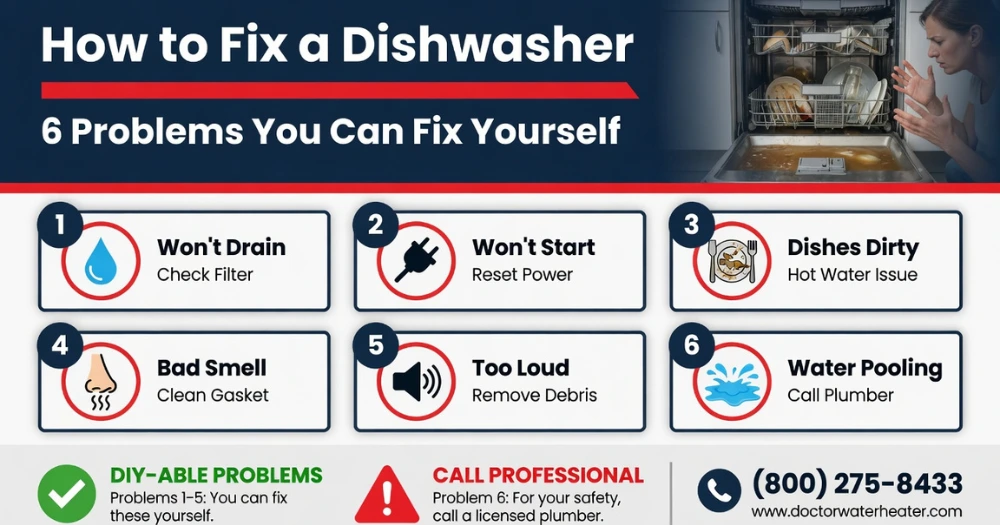
How to Fix a Dishwasher: Common Dishwasher Problems
|
Problem |
Likely Cause |
Can You Fix It Yourself? |
|
Won’t drain |
Clogged filter or drain hose |
Yes, usually |
|
Won’t start |
Door latch, tripped breaker, child lock |
Yes, usually |
|
Dishes still dirty |
Low water temperature, blocked spray arm |
Sometimes |
|
Bad smell |
Trapped food, dirty gasket |
Yes |
|
Loud noises |
Loose utensil, worn pump |
Depends on cause |
|
Water pooling underneath |
Door seal or supply line leak |
Call a plumber |
Problem 1: Dishwasher Won’t Drain
Standing water in the tub after a cycle almost always means something is blocking the flow.
Start With the Filter
The filter is usually a removable cylinder at the bottom of the tub. Pull it out and rinse it under warm water. Food particles collect here faster than most people expect, and this alone solves the problem more often than not.
Then Check the Hose
If the tub is still holding water, check the drain hose where it connects to the sink or garbage disposal. A kinked or clogged hose is the next most common culprit, and if your dishwasher drains through a disposal, running it for a few seconds can clear a blockage you didn’t know was there.
Problem 2: Dishwasher Won’t Start
No lights, no hum, nothing happens.
Check These Three Things
Start with the door latch, since dishwashers won’t run if the door isn’t fully closed and locked. Next, flip the breaker off and back on, which resets most control boards. Also check for a child lock setting, easy to trigger by accident on newer models.
If Nothing Works
If power is confirmed and the door is latching properly, the control panel itself may need service.
Problem 3: Dishes Come Out Dirty or Cloudy
This is the one homeowners usually blame on the dishwasher, but the real issue is often upstream, at the water heater.
Why Water Temperature Matters
Most dishwashers heat some of their own water internally, but they still rely on incoming water at roughly 120°F to start the cycle efficiently. Water that arrives too cold forces the unit to spend extra time heating before it can clean effectively, which can leave dishes with a filmy residue even when the dishwasher itself is working fine.
How to Check Yours
Run the hot tap near the kitchen for a minute before starting a load. If it’s not getting properly hot, your water heater’s thermostat may have drifted low, or the unit may be struggling with age or sediment buildup. Our water heater FAQ page covers the standard 120°F household setting and when it makes sense to run hotter.
If Temperature Checks Out
The problem is more likely a blocked spray arm. Pull it off, clear clogged holes with a toothpick, and make sure it spins freely once reattached.
Problem 4: Dishwasher Smells Bad
Odor usually means grease or food debris has built up somewhere the wash cycle isn’t reaching.
The Vinegar Fix
Clean the filter and drain area first, then run an empty cycle with a bowl of white vinegar on the top rack. It cuts through grease buildup better than most people expect from something already in the pantry.
Don’t Skip the Gasket
Wipe down the rubber door gasket while you’re at it. Food particles collect there more than most homeowners realize, and it’s an easy spot to overlook.
Problem 5: Dishwasher Is Too Loud
A dishwasher that suddenly gets noisy is usually telling you something got where it shouldn’t be.
What to Look For
Check first for a stray fork or lid at the bottom interfering with the spray arm, then broken glass or hardened food debris in the pump housing.
When It’s Age, Not a Fluke
If the unit is older than 10 years and has been getting progressively louder over several months, that’s often worn pump bearings rather than a one-time blockage.
Problem 6: Water Pooling Under the Dishwasher
This is where we’d tell you to stop DIY-ing, not because it’s hard, but because it’s easy to make worse.
Where Leaks Usually Come From
A leak under the dishwasher can come from the door gasket, a loose hose clamp, or a failing water supply line connection.
When to Call a Plumber
If you’ve ruled out the gasket and hoses and water is still showing up on the floor, the supply line fitting may be corroding at the shutoff valve. A slow leak behind cabinetry can cause real damage before anyone notices it. Our team handles dishwasher supply line and hookup work as part of our plumbing services across Morris County, including new installations and reworking older connections that were never up to code.
A Straightforward Note on What We Do (and Don’t Do)
We’ll say this plainly: Doctor Water Heater doesn’t repair the internal mechanics of a dishwasher. The pump, control board, or heating element inside the unit itself is appliance-repair territory, not plumbing.
What We Actually Handle
We take care of everything connected to it: the water supply line, the shutoff valve, drain connections, and the water heater feeding it hot water in the first place. If your “dishwasher problem” turns out to be a water heater underperforming, or a supply line that needs replacing during a kitchen renovation, that’s our lane. Our plumber in Denville, NJ team handles dishwasher hookups regularly as part of kitchen plumbing work.
When It’s Actually the Water Heater
If dishes never come out fully clean, and showers have also felt lukewarm lately, don’t rule out the water heater. A unit losing efficiency, carrying heavy sediment, or simply undersized for the household can quietly cause both problems at once.
Regular water heater maintenance, an annual flush and inspection keeps sediment from insulating the heating element and dragging down output temperature over time. It’s a cheap fix compared to replacing an appliance that was never actually broken.
FAQ: Fixing a Dishwasher
Can I repair my dishwasher myself?
Minor issues: clogged filters, blocked hoses, dirty gaskets, loose latches are usually DIY-friendly. Pump, motor, or control board issues are best left to an appliance technician.
Why does my dishwasher leave a cloudy film on glasses?
Most often it’s hard water minerals or water that isn’t hot enough to fully dissolve detergent. Try a rinse aid first, and check your water heater’s temperature setting if the problem persists.
Is it worth repairing an older dishwasher?
If the repair costs more than half the price of a new unit, replacement usually makes more sense, especially past the 10-year mark.
Why is there water under my dishwasher?
Check the door gasket and hose connections first. If those are fine, the supply line fitting may be the source, and that’s worth having a plumber look at before it causes water damage.
Should I turn up my water heater for my dishwasher?
Not usually. Most modern dishwashers heat their own water internally once it enters at the standard 120°F household setting. Turning the water heater up further mainly adds scalding risk without much cleaning benefit.
How do I fix a dishwasher that’s not working properly?
Start with the filter: rinse it under warm water, check the drain hose for clogs, and verify your incoming water temperature is at least 120°F. If those don’t solve it, the issue is likely internal and needs an appliance technician.