
Your water heater is one of those appliances you never think about — until it stops working. By the time most homeowners notice something is wrong, the unit has already been declining for months. Knowing how long a water heater should last, what shortens its life, and what the warning signs of failure look like can save you from a cold shower, a flooded utility room, or an emergency replacement call on a Sunday morning.
How Long Does a Water Heater Last on Average?
The honest answer depends on the type of unit you have, how well it has been maintained, and the water quality in your area.
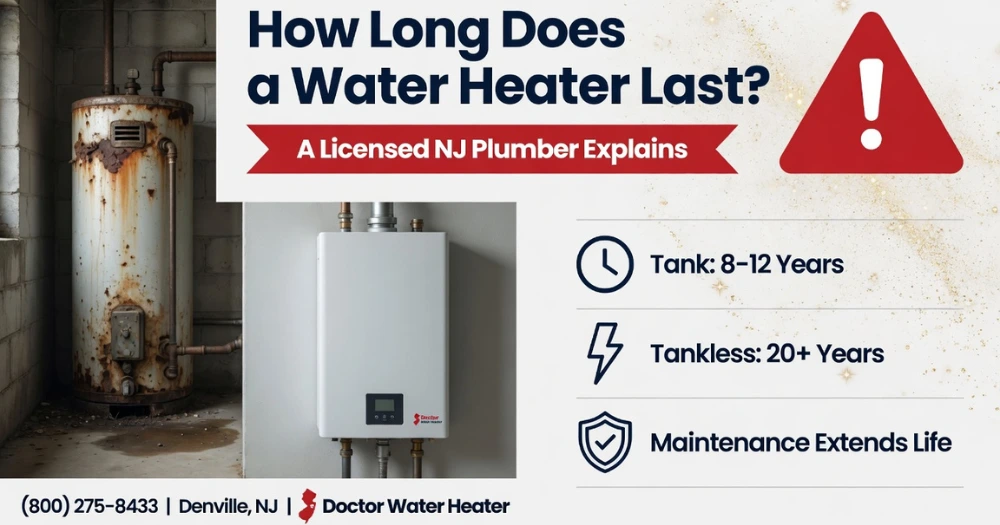
Traditional tank water heaters — the most common type in NJ homes — have an average lifespan of 8 to 12 years. Some units push past 12 years with excellent maintenance and soft water. Others fail before 8 years in hard water areas where sediment accumulates rapidly and is never flushed out.
Tankless water heaters last significantly longer — typically 20 years or more when properly maintained. This is one of the most compelling long-term arguments for going tankless: you are essentially getting double the lifespan compared to a standard tank unit, which more than offsets the higher upfront installation cost over time.
Indirect water heaters connected to a boiler system can also last 20+ years since they have fewer components exposed to constant heating cycles.
These are averages. Your specific unit may fall shorter or longer depending on the factors below.
What Determines How Long a Hot Water Heater Lasts?
Water Quality
This is the single biggest factor for NJ homeowners. Morris County has moderately hard water, and homes on private wells often have even harder water with higher mineral content. Hard water accelerates sediment accumulation inside the tank, which corrodes the tank lining, strains the heating element, and shortens lifespan considerably. A water heater in a hard water home that is never flushed may fail in six to seven years. The same unit with annual flushing and an anode rod that is replaced on schedule can reach 12 years or beyond.
Maintenance History
Annual draining and flushing removes the sediment that causes most water heater failures. Equally important is the sacrificial anode rod — a magnesium or aluminum rod installed inside the tank specifically to attract corrosive elements and corrode in place of the tank walls. When the anode rod is depleted and not replaced, the tank itself becomes the target of corrosion. Most homeowners have never heard of the anode rod, let alone replaced it. This single oversight is responsible for a significant portion of premature water heater failures.
Water Pressure
Consistently high water pressure — above 80 PSI — puts constant stress on the tank walls, connections, and the temperature and pressure relief valve. Over time this accelerates wear on every component. A pressure reducing valve on the main water line protects the entire plumbing system, including the water heater.
Unit Quality and Brand
Not all water heaters are built equally. Entry-level units installed by big box retailers often carry six-year warranties on the tank. Higher-quality units from Bradford White — a brand we install regularly at Doctor Water Heater — carry longer warranties and are built with thicker tank linings and better components that hold up longer under real-world conditions.
Installation Quality
A water heater that was improperly sized for the household demand, installed without proper venting, or set up with incorrect temperature and pressure settings will wear out faster regardless of brand. Professional installation by a licensed master plumber ensures the unit is set up correctly from day one.
How Long Should a Water Heater Last With Proper Maintenance?
With annual draining and flushing, regular anode rod inspection and replacement, and professional service every few years:
- Tank water heater: 10 to 12 years, sometimes longer
- Tankless water heater: 20 years or more
- Indirect water heater: 20+ years
Without maintenance in a hard water area like Morris County:
- Tank water heater: 6 to 8 years, sometimes less
- Tankless water heater: 10 to 15 years before efficiency drops significantly
The difference between a maintained and unmaintained unit in New Jersey is often four to six years of additional useful life — and thousands of dollars in premature replacement costs.
Signs Your Water Heater Is Failing
Knowing when a water heater is approaching the end of its life allows you to plan a replacement on your schedule rather than reacting to an emergency. Here are the clearest warning signs:
Age Over 10 Years
If your tank water heater is past the 10-year mark, it is worth having it evaluated even if it appears to be working normally. Failures in older units can happen suddenly — a pinhole leak becomes a tank rupture, or a corroded valve fails without warning. At 10 years, the cost-benefit calculation often favors proactive water heater replacement over continued repair.
Check the serial number on the unit — the first four digits typically encode the manufacture date. If you are unsure, a plumber can tell you the unit’s age immediately.
Leaking Around the Base
Water pooling around the base of the tank is a serious sign. Small leaks from the drain valve or connections can sometimes be repaired, but water seeping directly from the tank body indicates internal corrosion that has progressed through the tank wall. This is not repairable — the unit needs to be replaced, and the sooner the better. A leaking water heater can fail completely without much additional warning.
Rusty or Discolored Water
Rust-colored water coming from hot taps — but not cold — points to corrosion inside the tank. This can sometimes mean the anode rod is fully depleted and needs replacement, but in older units it often means the tank lining itself has corroded. A plumber can assess which is the case. Metallic-tasting or -smelling hot water is a related symptom that should not be ignored.
Running Out of Hot Water Faster Than Usual
If your household usage has not changed but you are running out of hot water sooner, sediment has likely displaced significant tank capacity. Heavy sediment buildup can reduce effective tank volume substantially — a 50-gallon tank may deliver the hot water performance of a 35-gallon unit. This can sometimes be improved with a thorough flush, but in older units with severe buildup it signals that replacement is the better investment.
Rumbling, Popping, or Knocking Sounds
These noises are sediment. As mineral deposits harden at the tank bottom, water trapped beneath them boils and forces through the buildup, creating the sounds homeowners describe as rumbling or knocking. In early stages this is a maintenance issue. In a unit that has been noisy for years, it typically indicates the sediment has hardened beyond what flushing can remove.
Rising Energy Bills Without Explanation
If your gas or electric bills have been climbing steadily without a change in usage, your water heater may be working harder than it should to compensate for sediment insulation, a failing heating element, or a thermostat issue. A unit that is losing efficiency is costing you money every month — sometimes enough to justify early replacement.
Frequent Repairs
One repair on a water heater is usually worth doing. Two repairs in a short period, or a repair on a unit that is already over eight years old, often means the money would be better invested in replacement. The general rule: if the repair cost exceeds 50% of a new unit’s cost and the existing unit is over eight years old, replace it.
Repair or Replace? How to Decide
Some water heater problems are straightforward repairs:
- Faulty thermostat — replacement is inexpensive and extends unit life
- Failed heating element — common on electric units, relatively affordable fix
- Bad gas valve or igniter — worth repairing on a unit under eight years old
- Depleted anode rod — replacement is simple maintenance, not a repair
- Leaking drain valve — inexpensive valve replacement
Problems that typically warrant replacement rather than repair:
- Tank body corrosion or active leaking from the tank wall
- Unit over 10 years old with multiple issues
- Significant sediment buildup that cannot be cleared
- Repeated failures of the same component
- Efficiency that has declined despite maintenance
At Doctor Water Heater, Anthony Intile gives homeowners a straight answer: if repair makes sense, we say so. If replacement is the smarter financial decision, we tell you that too — along with options that fit your home and budget.
Tank vs. Tankless: Which Lasts Longer?
If long-term value matters to you, the math strongly favors tankless — a position supported by ENERGY STAR, which certifies tankless units for their superior efficiency and longer service life. A tank water heater installed today will likely need replacement in 10 to 12 years. A tankless unit installed at the same time — properly maintained — will still be running 20 years from now, potentially outlasting two full tank unit replacement cycles.
The upfront cost of a tankless installation is higher. But when you factor in the longer lifespan, lower operating costs, and the elimination of standby heat loss, the total cost of ownership over 20 years typically favors the tankless unit.
For NJ homeowners in the Denville and Morris County area who are already facing a tank replacement, it is worth having a conversation about whether a tankless water heater is the right upgrade for your home before defaulting to a like-for-like replacement.
Frequently Asked Questions
How do I know how old my water heater is?
Check the serial number on the label attached to the unit. Most manufacturers encode the manufacture date in the first few characters — typically the first letter represents the month and the next two digits represent the year.
Can a water heater last 20 years?
Tank water heaters rarely reach 20 years, though it is possible with exceptional maintenance and soft water. Tankless water heaters routinely reach 20 years and beyond with annual descaling and proper care.
Is it worth repairing a 10-year-old water heater?
It depends on what is failing. Minor components like thermostats and heating elements are worth replacing even on a 10-year-old unit.
What shortens a water heater’s lifespan the most?
In New Jersey, hard water combined with no maintenance is the most common cause of premature failure. Skipping annual flushing, never replacing the anode rod, and ignoring early warning signs collectively cut years off a unit’s useful life.
Water Heater Replacement in Denville, NJ
If your water heater is approaching 10 years, showing warning signs, or has already failed, Doctor Water Heater provides fast, professional replacement and installation throughout Denville, Morristown, Parsippany, Randolph, Mountain Lakes, and surrounding Morris County and Bergen County communities.
We carry and install Bradford White, Navien, Rinnai, Rheem, and AO Smith units — tank and tankless — and provide free estimates on all replacements.
Contact us today for a free estimate.
📞 (800) 275-8433 | Denville, NJ 07834