
Your water heater is acting up. You get a quote from a plumber and the price makes you wince.
But what if you could handle some repairs yourself? Or at least understand which parts can be replaced without turning a simple job into a dangerous disaster?
This guide breaks down which water heater parts you can replace, which ones require professional help, and what it actually costs so you can make the right decision.
Which Water Heater Parts Can You Actually Replace?
Some parts are straightforward enough for a confident DIYer, while others involve risks that make professional help the smarter option.
Safe for experienced DIYers
- Anode rod (with caution)
- Drain valve
- Dip tube
- Pressure relief valve (in some cases)
Possible if you’re skilled
- Heating element (electric only)
- Thermostat (electric only)
- Expansion tank
Not recommended for DIY
- Thermocouple (gas)
- Gas control valve
- Gas burner assembly
- Tank itself
Electric Water Heater Parts (Safest for DIY)
Heating Element (Electric Only)
The heating element is what heats your water inside the tank. Most electric water heaters have two elements.
- No hot water or only lukewarm water
- Water runs out quickly
- Heating takes longer than normal
Cost: $20–$80 for the part, $150–$300 professionally.
DIY? Possible if you are comfortable with electrical work. Otherwise, hiring a professional is safer.
Thermostat (Electric Only)
The thermostat controls when your water heater turns on and off.
Signs it’s failing:
- Water temperature fluctuates
- Water suddenly becomes lukewarm
- One heating section stops working
Cost: $20–$30 for the part, $150–$200 professionally.
DIY? Yes. This is one of the easiest and safest repairs.
Anode Rod (Gas and Electric)
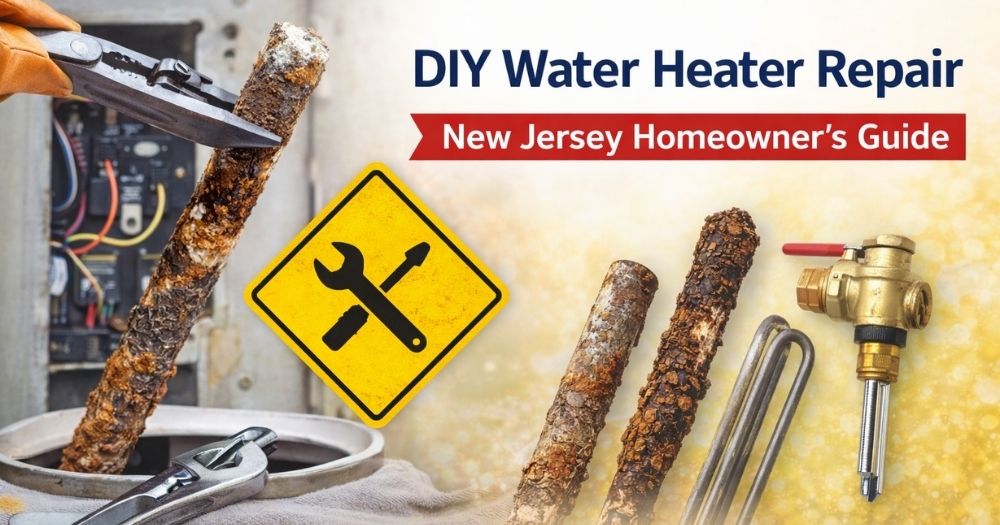
The anode rod protects your tank from rust by corroding itself first.
Signs it needs replacement:
- Rotten egg smell
- Rusty water
- Noisy tank
Cost: $20–$50 DIY, $250–$300 professionally.
DIY? Yes, but it can be difficult if the rod is stuck.
New Jersey note: Hard water causes faster wear. Check every 2–3 years.
Drain Valve
The drain valve allows you to empty your tank for maintenance.
Signs it needs replacement:
- Leaks
- Won’t open or close
Cost: $15–$30 DIY, $75–$150 professionally.
DIY? Yes. One of the easiest repairs.
Pressure Relief Valve
This safety valve prevents dangerous pressure buildup inside the tank.
Signs it’s failing:
- Leaking water
- Corrosion
Cost: $20–$50 DIY, $75–$250 professionally.
DIY? Possible, but be careful since this is a safety component.
Dip Tube
The dip tube directs cold water to the bottom of the tank.
Signs it’s failing:
- Water turns lukewarm quickly
- Inconsistent water temperature
Cost: $10–$25 DIY, $100–$200 professionally.
DIY? Yes, but requires draining the tank.
Expansion Tank
An expansion tank absorbs pressure when water heats up.
Signs it’s failing:
- High pressure
- Leaks
Cost: $80–$150 DIY, $150–$300 professionally.
DIY? Possible but requires precision to avoid leaks.
Gas Water Heater Parts (Higher Risk)
Thermocouple
This sensor controls gas flow based on the pilot light.
DIY? Not recommended due to safety risks.
Gas Control Valve
Controls the main gas supply.
DIY? Never attempt. Requires a licensed professional.
Pilot Light / Igniter
You can relight a pilot yourself, but repeated failure means a deeper issue.
Parts You Should Never Replace Yourself
- Water heater tank
- Burner assembly
- Venting system
- Tankless internal components
New Jersey Considerations
- Hard water speeds up wear on parts
- Some repairs require permits and licensed plumbers
- Labor typically ranges from $75–$150/hour
The Bottom Line
Some water heater repairs are simple and worth doing yourself. Others involve risks that make professional help the smarter and safer option.
Anode rods and drain valves are great DIY projects. Heating elements and thermostats can be handled if you’re experienced. Gas-related repairs and major components should always be left to professionals.
If you’re unsure, getting a professional opinion first can save you time, money, and potential damage.
Doctor Water Heater serves Morris County, Bergen County, Essex County, and surrounding New Jersey areas.
Call us for a free estimate: (800) 275-8433
Frequently Asked Questions About Water Heater Repairs
Before replacing any water heater parts, here are some of the most common questions New Jersey homeowners ask when deciding whether to DIY or call a professional.
Which water heater parts are safe to replace yourself?
Some parts like the drain valve, thermostat (electric units), dip tube, and anode rod can be replaced by homeowners with basic tools and experience. These are considered lower-risk repairs compared to gas or internal system components.
What water heater repairs should never be DIY?
Repairs involving gas components such as thermocouples, gas control valves, burner assemblies, or venting systems should never be done yourself. These involve safety risks like gas leaks and carbon monoxide exposure and should always be handled by a licensed professional.
How do I know if I should repair or replace my water heater?
If your water heater is under 8–10 years old and the issue is a replaceable part like a thermostat or heating element, repair is usually the better option. If the tank itself is leaking, corroded, or over 12–15 years old, replacement is often more cost-effective.
Why do water heater parts fail faster in New Jersey?
New Jersey has hard water in many areas, which causes mineral buildup inside the tank. This leads to faster wear on components like the anode rod, heating elements, and dip tube, meaning they may need replacement more frequently than in other regions.