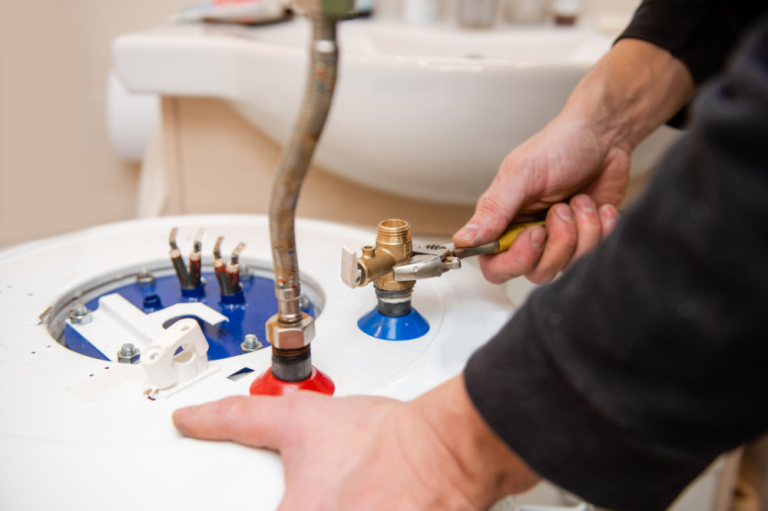

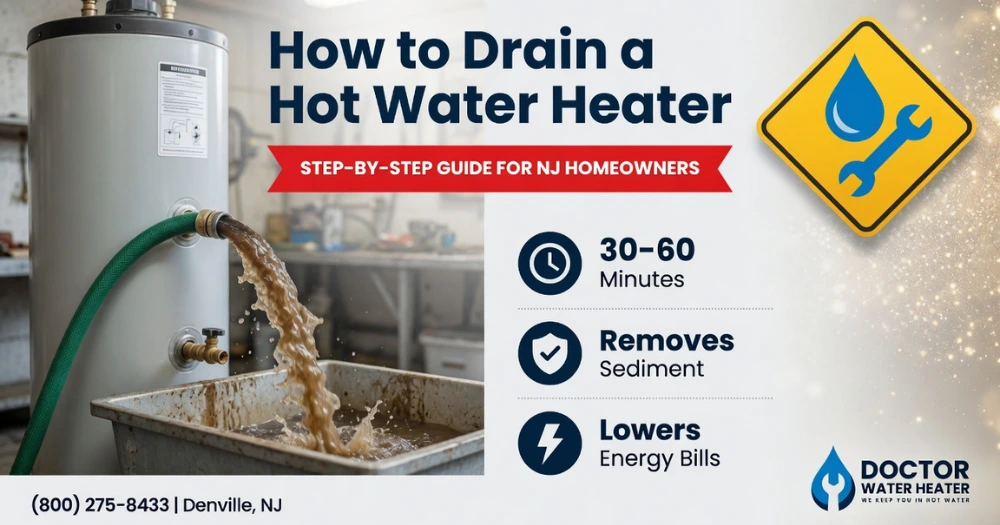
Your water heater quietly does its job every single day — heating water for showers, dishes, laundry, and more. But without regular maintenance, sediment and mineral deposits build up inside the tank and slowly rob it of efficiency, capacity, and lifespan. Draining your water heater is one of the simplest and most impactful things you can do to protect that investment.
This guide walks you through exactly how to drain a hot water heater safely, what tools you need, how the process differs for gas and electric units, and when it makes more sense to call a licensed plumber rather than tackle it yourself.
Why Draining Your Water Heater Matters
Every gallon of water that flows into your tank carries dissolved minerals — primarily calcium and magnesium. Over time these minerals settle at the bottom of the tank and form a layer of sediment. In New Jersey, particularly in Morris County where water hardness is moderate to high, this process happens faster than homeowners expect.
Left unchecked, that sediment layer causes real problems:
Reduced efficiency — sediment insulates the bottom of the tank from the burner or heating element, forcing your system to use more energy to heat the same amount of water. This shows up directly in your utility bills.
Less hot water — as sediment accumulates it physically displaces water volume in the tank, meaning you get less usable hot water per cycle.
Noise — that rumbling, popping, or cracking sound coming from your water heater is almost always sediment. Water trapped beneath the hardened buildup boils and forces its way through, creating those sounds every time the unit fires.
Corrosion and leaks — sediment traps moisture against the steel tank floor and accelerates rust. Over time this leads to pinhole leaks and eventually tank failure.
Shortened lifespan — a water heater that is never drained may need replacement years before a properly maintained unit would.
Draining and flushing the tank removes this sediment before it causes lasting damage.
How Often Should You Drain Your Water Heater?
As the U.S. Department of Energy recommends, once per year is the standard maintenance interval for most NJ homeowners.
If your home is on well water or you notice heavy scale buildup on faucets and fixtures, draining every six months is a smarter approach. Well water in Morris County often carries higher mineral content than municipal supply, which accelerates sediment accumulation significantly.
Also keep in mind — if your water heater has never been drained and is several years old, do not attempt a DIY drain without reading the caution section below first. Heavily sediment-loaded drain valves can fail during the process.
What You Need Before You Start
Gather these items before beginning:
- Garden hose long enough to reach a floor drain, utility sink, or outdoor area
- Flathead screwdriver (some drain valves require this to open)
- Work gloves — draining water will be hot
- Bucket for catching initial drips at the valve
- Non-contact voltage tester (optional but recommended for electric units)
Read your owner’s manual before starting. Bradford White, Rheem, AO Smith, and Navien units all have minor differences in valve location and shutdown procedures.
How to Drain a Hot Water Heater: Step-by-Step
Step 1 — Shut Off the Cold Water Supply
Locate the cold water inlet valve at the top of the tank and turn it off. This stops new water from entering while you drain.
Step 2 — Turn Off the Power or Gas
This step is critical — never drain a water heater with the heating source still active.
Electric water heater: Go to your electrical panel and flip the breaker connected to the water heater to OFF. If you are unsure which breaker it is, use a non-contact voltage tester at the unit to confirm power is off before proceeding. Energized heating elements that are not submerged in water will burn out in seconds — a repair that costs far more than the maintenance you are trying to do.
Gas water heater: Turn the thermostat dial to the “pilot” setting, or shut the gas supply valve off completely if your manufacturer recommends it. Do not leave the unit in active heating mode during the drain.
Step 3 — Let the Water Cool
Water inside the tank is typically stored at 120°F or higher. Draining scalding water is a burn hazard and can damage certain drain locations. For safety, shut off the power or gas and let the unit cool for at least two to three hours before draining. Overnight cooling is ideal.
If you need to drain the unit the same day, running several hot showers beforehand will draw down the tank temperature faster.
Step 4 — Open a Hot Water Faucet Inside the House
Open a hot water tap somewhere in the home — a bathroom or kitchen sink works well. This relieves pressure in the system and allows the tank to drain freely by admitting air. Leave this faucet open throughout the entire draining process.
Step 5 — Connect the Hose to the Drain Valve
The drain valve is located near the bottom of the tank, typically on the front. It resembles a standard hose bib. Connect your garden hose securely and route the other end to your drainage point — a floor drain, utility sink, driveway, or outdoor area that can safely handle hot water runoff.
Make sure your drainage point is lower than the drain valve — water drains by gravity here.
Step 6 — Open the Drain Valve
Open the drain valve using your hand or a flathead screwdriver depending on valve type. Water will begin flowing through the hose immediately. It will still be warm even after cooling — keep hands and feet clear.
Be patient. A 50-gallon tank takes time to drain fully. If the water appears cloudy, brownish, or carries visible grit, that is sediment coming out — exactly what you are after.
If the valve clogs: This is common in tanks that have not been drained in several years. Try opening and closing the valve several times to break the clog loose. If it does not clear, do not force it — a deteriorated valve can crack and leak if over-pressured. Stop and call a water heater repair professional.
Step 7 — Flush the Tank with Fresh Water
Once the tank is empty, briefly turn the cold water inlet back on. Fresh water will stir up any remaining sediment at the bottom and push it out through the hose. Watch the water coming out — when it runs completely clear with no visible particles, the flush is done.
Turn the cold water inlet off again and let the remaining water drain out.
Step 8 — Close the Drain Valve and Refill
Close the drain valve tightly and disconnect the hose. Reopen the cold water inlet valve to refill the tank. Keep the hot water faucet inside the house open — you will hear air sputtering and spitting as the tank fills. When a steady, uninterrupted stream of water flows from that faucet with no air, the tank is full. Turn the faucet off.
Step 9 — Restore Power or Gas
Electric: Only restore power after the tank is completely full. Flip the breaker back on.
Gas: Return the thermostat from “pilot” to your normal temperature setting, or relight the pilot if you shut gas off completely. Follow your unit’s pilot lighting instructions carefully.
Step 10 — Check for Leaks
Inspect the drain valve and surrounding connections for dripping. A small amount of moisture at the valve immediately after reattaching is usually normal and stops within minutes. If leaking continues, tighten the valve further. Persistent leaking from the valve after a drain is often a sign the valve seat has worn and needs replacement — this is a quick fix for a plumber.
How to Drain a Gas Water Heater vs. Electric Water Heater
The draining process for gas and electric water heaters is nearly identical. The differences are:
Draining a gas water heater: Set the thermostat to “pilot” or shut off the gas supply valve before starting. When restoring after the drain, return to pilot or relight as needed. Never leave the burner in active mode during draining.
Draining an electric water heater: Shut off the breaker before starting and do not restore power until the tank is completely full. This is the most important safety distinction — exposed heating elements energized without water coverage will fail immediately.
Both types follow the same hose connection, drain, flush, and refill procedure.
When to Skip DIY and Call a Licensed Plumber
Draining a water heater is manageable for a confident homeowner on a unit that has been regularly maintained. But certain situations make professional service the smarter choice:
- The tank has not been drained in more than two or three years
- The drain valve is visibly corroded, stiff, or does not open smoothly
- Water does not flow when the valve is opened — the valve may be blocked with hardened sediment
- The unit is already showing signs of leaking
- You are not comfortable working near the electrical panel or gas shutoff
- The water heater is over ten years old and has no maintenance history
At Doctor Water Heater, Anthony Intile performs complete water heater draining and maintenance throughout Denville, Morristown, Parsippany, Randolph, and surrounding Morris County and Bergen County communities. A professional drain visit also includes inspection of the anode rod, pressure relief valve, and connections — components that a standard DIY drain does not address.
What Happens If You Never Drain Your Water Heater?
Sediment accumulates and eventually hardens into a concrete-like layer at the tank bottom. At that point it is no longer drainable through the standard valve — it requires professional intervention or tank replacement. Units that are never maintained in hard water areas like Morris County routinely fail years before their expected lifespan.
The noise, the rising energy bills, the shorter hot water supply — these are not random. They are predictable, preventable symptoms of a tank that needs draining.
Frequently Asked Questions
How often should I drain my hot water heater?
Once a year for most households. Homes on well water or in hard water areas should drain every six months.
How long does it take to drain a water heater?
Typically 30 to 60 minutes total including cooling time, draining, flushing, and refilling. If the tank has significant sediment buildup, draining may take longer.
Can draining a water heater cause damage?
On well-maintained units, no. On older units with corroded or stuck drain valves, forcing the valve can cause leaks or valve failure. This is why professional service is recommended for tanks that have not been drained in several years.
Do I need to drain a tankless water heater the same way?
No. Tankless water heaters do not have a storage tank to drain. They require a different process called descaling, which circulates a cleaning solution through the heat exchanger using a pump. See our tankless water heater maintenance guide for details.
What does rusty or discolored water mean when draining?
Brown or rust-colored water indicates significant sediment and possible tank corrosion. Clear this with thorough flushing. If discolored water persists from your taps after draining and refilling, have the unit inspected — internal corrosion may have progressed to a point where replacement is the better option.
Schedule Water Heater Draining in Denville, NJ
Annual draining is the single most impactful maintenance task for a tank water heater. Whether you want to handle it yourself with the steps above or prefer it done right by a licensed professional, Doctor Water Heater is here to help homeowners throughout Morris County and Bergen County.
Contact us today for a free estimate on water heater draining, maintenance, repair, or replacement.
📞 (800) 275-8433 | Denville, NJ 07834