

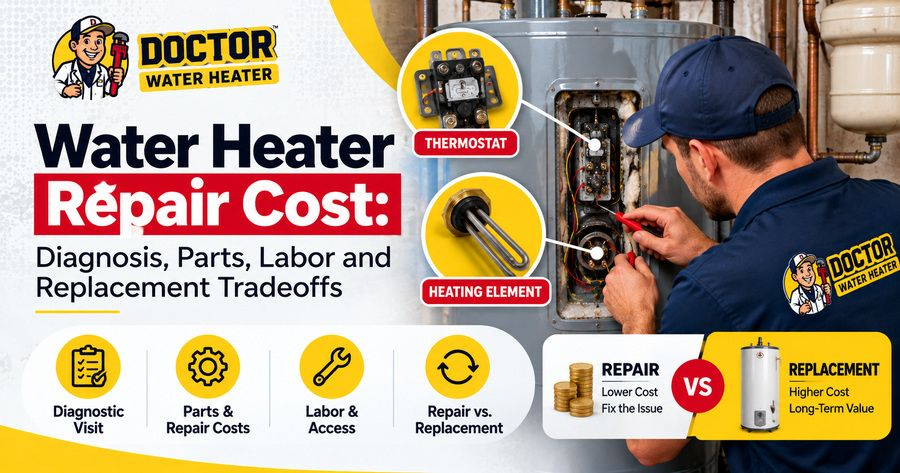
Water heater repair cost reflects two layers of work. The first is diagnosis, and the second is the combination of parts and labor that resolves the fault.
We frequently meet homeowners who have already paid for a part that was never at fault. A gas unit that will not stay lit may suggest a worn thermocouple, yet the underlying cause can sit in the gas control valve or the venting. Each misdirected part adds expense without restoring hot water.
A disciplined diagnosis isolates the failed component before the technician orders anything. In our experience, that single step does more to contain repair cost than any discount on parts.
Factors Affecting the Water Heater Repair Cost
Water heater repair cost is the total charge to restore a malfunctioning unit to safe operation without replacing the heater itself. The figure depends primarily on the failed component and the accessibility of the unit. Fuel type also matters, because gas and electric tanks fail in different ways from tankless systems.
A homeowner in Parsippany and another in Montclair may therefore receive different quotes for the same symptom. Most water heater repair NJ providers structure their charges around these same variables.
Stage One: The Diagnostic Visit
A diagnostic visit establishes the cause before any part changes hands. Many companies charge a water heater diagnostic fee to cover this time, and some credit it toward the approved repair.
Gas Units
A gas water heater repair begins with a check of whether the pilot or burner ignites and stays lit. The technician then evaluates the flame sensor or thermocouple before moving to the gas control valve. Venting receives attention as well, since poor draft can shut a burner down.
Electric Units
Electric diagnosis relies on a continuity test of each heating element, followed by a check of each thermostat. A tripped breaker often indicates a shorted element rather than a panel fault. When a homeowner reports a hot water heater not heating, a failed lower element ranks among the most frequent findings.
Tankless Units
Tankless units display an error code that narrows the search considerably. The technician then inspects the igniter and the flow sensor. Mineral scale on the heat exchanger frequently calls for descaling rather than a new component.
Stage Two: Parts and Their Repair Complexity
The failed part determines most of the variation in repair cost. The table below links common symptoms to the components that typically cause them.
| Symptom | Likely Component | Repair Complexity |
|---|---|---|
| No heat from a gas unit | Gas control valve | Moderate to high |
| Lukewarm water from an electric unit | Element or thermostat | Low to moderate |
| Rotten egg odor in hot water | Anode rod | Moderate |
| Discharge from the safety valve | T&P relief valve | Low to moderate |
| Hot water that runs out quickly | Dip tube | Moderate |
| Rumbling or popping sounds | Sediment buildup | Moderate |
| Repeated shutdowns on a vented unit | Draft inducer | Moderate to high |
Sourcing also shapes parts cost. Manufacturer-specific components for brands such as Navien or Bradford White may cost more than universal parts. Availability for older models can also extend the repair timeline.
A gas control valve replacement typically sits at the upper end of component repairs, because the valve governs fuel delivery and temperature control together. Power vent water heater repair carries similar weight when the inducer motor or its pressure switch fails.
Stage Three: Labor and Access
Labor reflects time and difficulty rather than the part alone. The same repair can demand very different effort in a Paramus split-level and a Wayne townhouse, because access determines how quickly a technician reaches the unit.
- Access: Units in tight closets or crawl spaces slow every stage of the work
- Drain-down: Internal component work requires draining the tank before disassembly
- System type: Power vent and combi systems involve additional controls and venting
- Timing: Emergency service outside standard scheduling typically carries a premium
An electric water heater element replacement illustrates the point. The part itself is modest, yet the work demands a full power shutdown and a partial drain before the technician can remove it.
Manufacturer Warranties Seldom Cover Labor
A covered part does not guarantee a free repair. Bradford White’s residential limited warranty, for example, supplies replacement parts exclusive of labor and installation costs. Homeowners therefore typically pay for the technician’s time even when the manufacturer provides the part.
Before authorizing a repair, homeowners should locate the serial number and confirm the remaining warranty term. An expired parts warranty shifts the entire component cost to the owner, which changes the repair calculation considerably.
Water Heater Repair vs. Replacement
The decision to repair or replace water heater equipment rests on five considerations.
- Tank integrity: Corrosion that breaches the tank cannot be repaired. A water heater leaking from the bottom generally requires replacement once a technician rules out a fitting or valve leak.
- Age against warranty term: A unit near or beyond its tank warranty term returns less value from a major repair.
- Component value: A major part on an aging unit warrants a side-by-side comparison with replacement before approval.
- Efficiency: Repair preserves the existing efficiency level, while replacement can introduce a higher-efficiency system.
- Compliance steps: New Jersey treats a like-capacity heater replacement as minor work under N.J.A.C. 5:23-2.17A. The owner or contractor must notify the local construction office before work begins. A permit application and an inspection follow.
Maintenance to Prevent Repeat Repairs
Many repair calls trace back to deferred maintenance. Periodic flushing removes accumulated minerals, and routine inspection of the sacrificial anode protects the tank lining.
Tankless owners benefit from scheduled scale removal, which keeps the heat exchanger efficient. The full range of water heater services includes this preventive work.
Schedule a Professional Diagnosis
Homeowners comparing repair against replacement benefit most from an accurate diagnosis first. Doctor Water Heater operates from Denville and provides water heater repair across Morris County and Bergen County. Its service area also reaches Essex County and Passaic County.
Are you looking for water heater repair services near Morristown and surrounding towns? Our licensed technicians service both tank-style and tankless systems.
Frequently Asked Questions
Which water heater repair typically costs the most?
On gas units, the gas control valve usually represents the most significant component repair. On tankless systems, heat exchanger or control board failures carry the highest parts cost. In either case, the repair deserves comparison with replacement when the unit is older.
Why do companies charge for a diagnostic visit?
A diagnostic visit covers the technician’s travel and testing time before any repair begins. Accurate testing prevents the replacement of parts that are not at fault. Some companies credit the charge toward the approved repair.
Does tankless water heater repair cost more than a tank repair?
Repairs on tankless units often involve manufacturer-specific components and more complex controls. As a result, it frequently costs more than a comparable repair on a tank unit. Routine scale removal remains a relatively modest service by comparison.
Can a homeowner replace a thermocouple without a plumber?
Water heater thermocouple replacement is mechanically simple, but it involves the gas supply. Incorrect installation can create a gas leak or a pilot that fails repeatedly. A licensed professional should handle any work on gas components.
Does homeowners insurance cover water heater repair?
Coverage varies by policy, but standard policies generally exclude failures from age or wear. Some policies cover sudden water damage that a failure causes. Homeowners should review their own policy terms before filing a claim.