
Key Takeaways
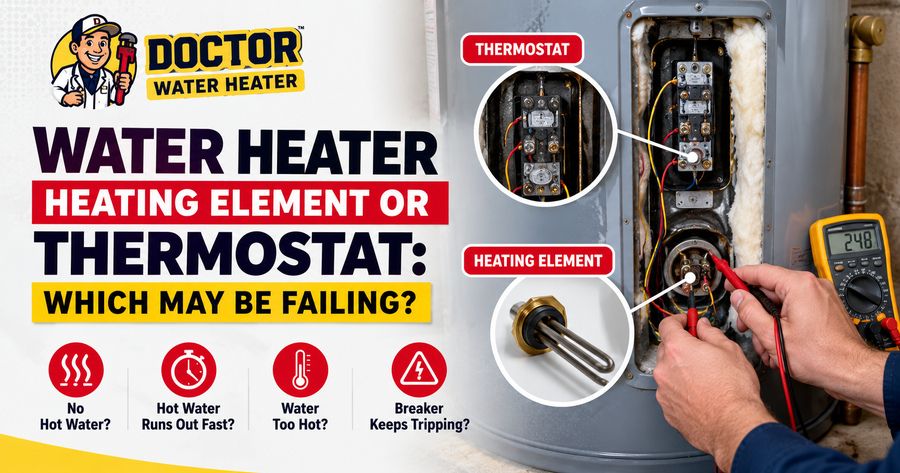
- No hot water at all often points to the upper element or upper thermostat.
- Hot water that runs out fast often points to the lower element.
- A reset button that trips again and again can signal a stuck thermostat.
- A multimeter test confirms the failed part before you buy anything.
- Live checks involve 240 volts, so a licensed technician should handle them.
Your electric water heater must have stopped working, and you are feeling annoyed. The cause must be in one of two parts. Their symptoms overlap, so a guess is risky.
A heating element is a metal rod that heats the water inside the tank. A thermostat is the switch that tells each element when to turn on and off. If an element shows an open reading on a meter, the element has failed. If the element tests good but gets no power when the water is cold, the thermostat is the likely fault.
Working Principles of Water Heater Elements and Thermostats
Many standard electric water heaters use two heating elements. One sits near the top of the tank, and the other sits near the bottom. Each element has its own thermostat behind a metal access panel on the side of the tank.
In a typical two-element tank, the elements do not run at the same time. The upper thermostat heats the top of the tank first. Once that water reaches the set point, the upper thermostat sends power down to the lower element.
The upper thermostat also carries a safety device called the high-limit switch, or energy cut-off (ECO). This switch shuts off both elements if the water gets too hot. It has a red reset button.
Because the upper thermostat runs the whole sequence, one failed part can stop heating for the entire tank.
Bad Water Heater Element vs. Thermostat: Signs and Differences
The table below matches common symptoms to the part most likely at fault in a water heater heating element or thermostat failure. Treat it as a starting point, not a final diagnosis.
| Symptom | Most Likely Cause | Why It Happens |
|---|---|---|
| No hot water at all | Upper element or upper thermostat | The lower element never gets power when the upper side fails |
| Hot water runs out fast | Lower element or lower thermostat | Only the top section of the tank heats |
| Lukewarm water at every tap | Low setting or drifting thermostat | The thermostat shuts off the element too early |
| Water too hot, reset trips | Stuck thermostat or grounded element | The element keeps heating past the set point |
| Breaker trips soon after reset | Shorted or grounded element | The element leaks current to the tank |
| Popping or rumbling sounds | Sediment around the lower element | Mineral buildup traps heat at the element |
Signs of a Bad Water Heater Heating Element
Heating elements wear out over time. Hard water can coat them with mineral scale. That scale holds heat against the element, and the element can overheat until it burns through.
Common bad water heater element symptoms include:
- Hot water that lasts only a few minutes
- Water that takes far longer than usual to reheat
- A breaker that trips soon after you reset it
- No hot water at all when the upper element fails
An element can also fail from dry firing. Dry firing happens when power reaches the element before the tank fills with water. With no water around it, the element can burn out very quickly. It often happens right after a new install or a tank drain.
A failed lower element is a frequent reason homeowners ask why their hot water runs out so fast. The upper element still heats the top section, so the first shower feels normal before the supply drops off.
Common Signs of a Bad Water Heater Thermostat
A thermostat fails in one of two ways. Its contacts can stick open, so the element never turns on. Or its contacts can weld shut, so the element never turns off.
A thermostat stuck open looks a lot like a dead element. On a meter, the element tests good, yet the thermostat sends it no power when the water is cold.
A thermostat stuck closed causes the opposite problem. The water climbs past the setting until the high-limit switch trips. Scalding tap water needs prompt attention.
Thermostats can also drift. The U.S. Department of Energy notes that thermostat dials are often inaccurate. It recommends checking the real temperature with a thermometer at a tap, and it says most households only need 120°F.
Lukewarm water from electric water heater units often traces back to a dial set too low or a thermostat that reads wrong. If the tap reading sits far below the dial setting, the thermostat deserves a closer look.
What the Red Reset Button Indicates
The reset button gives an early clue. Turn off the circuit breaker first. Then remove the upper access panel and fold back the insulation to reach the button.
If the button clicks when you press it, the water got too hot and tripped the ECO. That result points toward a grounded element or a thermostat stuck closed. When a water heater reset button keeps tripping, the root problem remains, and pressing it again will not solve it.
If the button does not click, the high-limit switch did not trip. The next suspect is the upper element. If the upper element tests good, the upper thermostat becomes the likely cause.
How to Check if a Water Heater Element or Thermostat Has Failed
- O. Smith’s no-hot-water troubleshooting guide lays out the basic sequence:
- Check for 240 volts at the top two screws of the upper thermostat. No voltage points to the breaker or the wiring.
- With the power off, disconnect the element wires. Measure resistance across the two element screws.
- A good element reads 5 to 25 ohms, with 12.5 ohms as typical. A reading outside that range means the element needs replacement.
- Check each element screw against the metal tank. An “OL” reading means no short. Any lower reading means the element has a ground fault.
- If both elements test good, the thermostat is the likely fault.
Step 1 requires live power. Contact with 240-volt terminals can cause serious injury, so this step belongs with a licensed professional.
Upper vs. Lower Water Heater Thermostat: Which Fails First?
The lower side of the tank handles most of the daily work. Cold water enters near the bottom through the dip tube, so the lower element cycles more often. The A. O. Smith guide notes that the lower thermostat is more likely to fail before the upper one for this reason.
Sediment adds more stress. Minerals settle at the bottom of the tank and collect around the lower element. Homes with hard water see this more often
A recovery test can point to the lower side. A State Water Heaters technical bulletin sets both thermostats to 130°F, then measures the starting tap temperature. A reading between 120°F and 140°F means the thermostats work as intended.
The test then runs hot water until about 60% of the tank empties. The tap temperature should drop only about 30°F. A larger drop points to the lower element or the dip tube.
When to Repair or Replace Your Electric Water Heater
Elements and thermostats rank among the water heater parts you can replace without buying a new tank. On a tank in good shape, one part swap often restores full hot water.
Age changes the decision, since an older tank may soon show corrosion or a worn anode rod. No repair can fix a leak in the tank body, so that problem calls for replacement.
Routine care helps both parts last longer. The U.S. Department of Energy lists flushing a quart of water from the tank every three months as part of storage water heater maintenance.
Water Heater Element and Thermostat Repair in Denville, NJ
Testing elements and thermostats means working around live 240-volt circuits. Doctor Water Heater provides water heater repair for homeowners in Denville and across Morris County, New Jersey.
A licensed technician can test both elements and both thermostats, then explain whether a repair or a replacement makes more sense.
Schedule a diagnosis today!
Frequently Asked Questions
Why is my electric water heater not heating?
An electric water heater not heating at all usually has a power problem or a failure on the upper side of the tank. Check the circuit breaker first, then the red reset button on the upper thermostat. If both look normal, the upper element or upper thermostat is the most likely cause.
Can a heating element fail without tripping the breaker?
Yes. When an element burns open, it stops drawing current, so the breaker has no reason to trip. A resistance test with a multimeter confirms an open element.
What temperature should an electric water heater be set at?
The U.S. Department of Energy states that most households only need a setting of 120°F. Many electric tanks have two thermostats, one for each element. Set both to the same temperature, and confirm the result with a thermometer at a tap.
Is it safe to test a water heater element yourself?
Resistance tests happen with the power off, but the voltage check at the thermostat requires live 240-volt power. A licensed technician has the training and tools to perform it safely.
Why does my water heater make popping sounds?
Popping or rumbling usually comes from sediment at the bottom of the tank. Water trapped under the minerals turns to steam and makes noise as it escapes. Regular flushing helps.
When does a new element or thermostat stop making sense?
A part replacement makes less sense when the tank leaks or shows heavy rust. Repeated failures and age point the same way.