
If you’ve lived in New Jersey for any amount of time, you’ve probably noticed something irritating: stubborn white deposits on your shower doors, spots on your dishes even after washing, or soap that just won’t lather properly. These aren’t signs of poor cleaning. They’re signs of something you can’t see but definitely feel: hard water.
New Jersey has a hard water problem that’s significantly worse than most of the country. And if you own a water heater, that problem is actively shortening its lifespan right now, costing you hundreds of dollars in wasted energy every year.
Let’s break down exactly why New Jersey’s water is uniquely challenging, what it’s doing to your water heater, and what you actually need to do about it.
Understanding Water Hardness: What Makes NJ Different
Water hardness is measured in parts per million (ppm) of dissolved minerals, primarily calcium and magnesium. The Water Quality Association classifies water hardness on a simple scale:
- Soft water: 0–60 ppm
- Moderately hard: 60–120 ppm
- Hard water: 120–180 ppm
- Very hard water: 180+ ppm
The national average across the United States is around 120 ppm, right at the threshold where water starts becoming problematic. Most Americans deal with moderately hard water that occasionally requires water softening considerations.
New Jersey is a different story entirely.
According to the U.S. Geological Survey, 89.3% of homes in the United States have hard water. But New Jersey significantly exceeds the national average. New Jersey has an average water hardness of 106 PPM, but cities like Trenton have extremely hard water at 222 PPM, while East Orange registers at 328 PPM (19 GPG), which is extremely hard. For comparison, Newark has softer water at 51 PPM.
The reason for this variation comes down to geology. Cities in Northern New Jersey that rely on surface water from reservoirs or rivers may generally have softer water, while areas in Central and Southern New Jersey that use groundwater from wells might have harder water due to the minerals from local bedrock dissolving into the water supply.
There are thick limestone layers in parts of New Jersey, particularly in Bergen County towns, and when groundwater moves through these layers, it picks up minute pieces of calcium and magnesium that eventually end up in your home’s plumbing system.
The specific service areas Doctor Water Heater covers tell the story: Morris County, Bergen County, and Essex County all have documented hard to very hard water conditions. Your water heater is fighting this challenge every single day.
How Hard Water Damages Your Water Heater
Here is where the problem gets serious.
When cold water sits in your pipes, the calcium and magnesium minerals stay dissolved. You can’t see them. But the moment that water gets heated, the exact moment it enters your water heater, everything changes chemically.
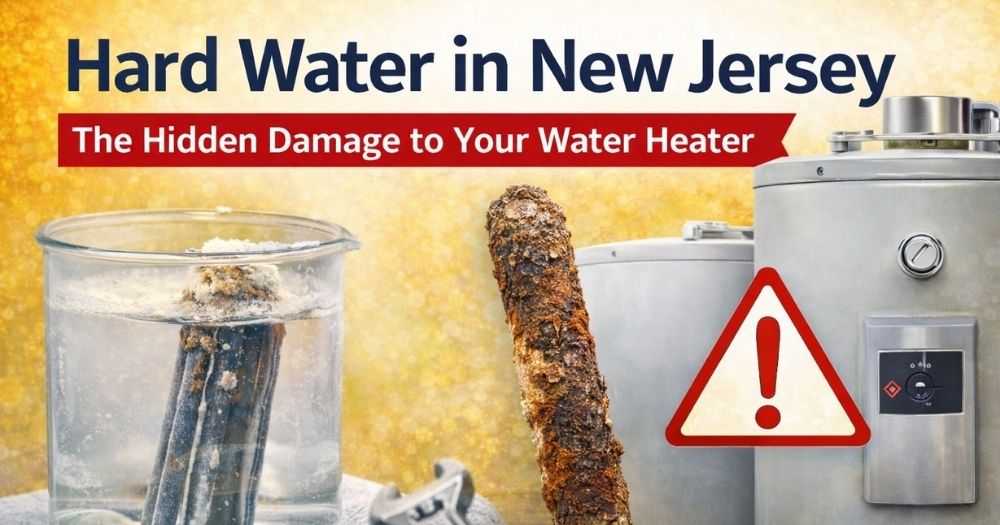
Heat causes dissolved minerals to precipitate out of solution and form solid deposits. These deposits settle at the bottom of your water heater tank and stick to the heating element. Plumbers call this scale. It’s the same white, crusty buildup you see on your shower doors, except it’s happening inside your tank where you can’t see the damage accumulating.
In soft-water states, this scaling process is gradual. A water heater might accumulate a thin layer of scale over many years without severe consequence. But in New Jersey, with water two to three times harder than the national average in many areas, the scaling process accelerates dramatically.
Here is what the timeline typically looks like for a New Jersey water heater:
Years 1–3
A thin layer of mineral scale forms on the heating element and tank bottom. Performance is still acceptable. You usually do not notice anything different yet.
Years 4–5
The scale layer thickens noticeably. Your water heater begins working harder to produce the same amount of hot water. You may notice your showers are not quite as hot, or it takes longer for water to heat up. Your energy bills may start creeping upward.
Years 6–8
Significant scale accumulation develops. The mineral layer now acts as an insulating barrier between the heating element or gas burner and the water. Your system has to work substantially harder to achieve the same temperature. The constant strain begins causing real wear on internal components.
Years 8–10
Heavy scaling and component fatigue set in. A water heater that should last 12 to 15 years in softer-water regions may now be near the end of its usable life. The constant hard work of fighting mineral deposits has worn out the heating element, stressed the tank, and degraded the anode rod.
Hard water reduces water heater lifespan by 25 to 40 percent, according to a study by the U.S. Department of Energy. This is not theoretical. It is a documented problem that affects real homes across New Jersey.
The Specific Challenge of New Jersey’s Water
It is not just that New Jersey has hard water. It is that New Jersey has hard water plus several other compounding factors that make the problem worse than it would be in other regions.
Aging Plumbing Infrastructure
New Jersey, particularly in Bergen County and Morris County, has many homes built before 1970. These older homes often have galvanized steel pipes that have been in service for decades. While the pipes themselves might still be functional, they can carry sediment and mineral particles picked up from aging municipal water distribution systems.
When that sediment-laden, mineral-heavy water reaches your water heater, you do not just get mineral scale. You get mineral scale plus sediment buildup on top of it. It is a double hit on your tank’s efficiency.
Municipal Water System Variations
One thing many homeowners do not realize is that the hardness of your water depends on which municipality supplies it. Jersey City has 140 ppm hardness. Nearby Paterson, Clifton, and Passaic have 89 ppm. Elizabeth registers at 97 ppm. Livingston is among the municipalities with higher hardness levels.
This variation means that a homeowner in one Bergen County neighborhood may have significantly harder water than someone just a few towns over. Your specific water hardness depends entirely on your municipal water source.
Winter Heating Demands
New Jersey winters are harsh. From November through March, homes are running heating systems, taking hot showers multiple times daily, and using dishwashers and washing machines constantly. Your water heater is working at maximum capacity for months at a time.
In milder climates, water heaters get a break during much of the year. In New Jersey, the workload is relentless. This sustained high demand, combined with hard water, accelerates component deterioration significantly faster.
Chlorine in Municipal Water
New Jersey municipalities add chlorine to water for public safety. But chlorine can also interact with hard minerals in ways that accelerate scale formation and increase corrosion inside water heater tanks. It is one more factor pushing New Jersey water heaters toward premature failure.
What’s Happening Inside Your Water Heater Right Now
If your water heater has not received professional service in the past year, here is what is almost certainly happening inside your tank:
Sediment Buildup
A layer of mineral deposits, mostly calcium carbonate and magnesium carbonate, is accumulating at the bottom of your tank. If your water heater is 4 to 8 years old, there may already be a noticeable layer of scale. If it is over 10 years old, the buildup can be substantial.
Reduced Efficiency
That sediment layer acts as insulation, blocking heat from reaching the water efficiently. Your water heater may be using 15 to 30 percent more energy than necessary to achieve the same temperature.
Anode Rod Deterioration
Your water heater contains a sacrificial anode rod, typically made of magnesium, that is designed to corrode instead of your tank. In soft-water areas, anode rods may last 5 to 7 years. In New Jersey’s hard water, they often fail in 3 to 5 years due to accelerated corrosion conditions.
Once your anode rod is gone, your tank begins corroding directly, which can eventually lead to leaks or tank failure.
Component Stress
Your heating element, if electric, or your gas burner, if gas, is working overtime. The constant battle against scale buildup causes thermal stress. Sensors that read water temperature may also get affected by mineral buildup, causing the system to overheat or underperform.
Tank Vulnerability
If your water heater is over 8 years old and has not been regularly flushed, the scale buildup may have already caused weak spots in the tank. Repeated heating and cooling, combined with mineral accumulation, can create conditions where leaks develop unexpectedly.
The Real Financial Cost
Ignoring hard water is expensive.
Annual energy waste: Many homeowners spend hundreds more per year in utility costs because scale buildup makes their water heater work harder.
Accelerated equipment replacement: Instead of replacing your water heater at year 15, you may be forced to replace it at year 10 or sooner.
Emergency replacement premium: A planned replacement is usually much cheaper than an emergency replacement after sudden failure.
Reactive part replacement: When you wait until an anode rod or other component has already failed, you often end up paying more than if you had handled it proactively.
Over one water heater lifespan, the cost of ignoring hard water can add up to thousands of dollars in wasted energy, early replacement, and emergency labor costs.
What New Jersey Homeowners Can Do
You have several options, ranging from basic maintenance to long-term system protection.
Annual Professional Flushing
This is the minimum baseline for New Jersey homes. Once a year, a professional can drain and flush your water heater to remove accumulated sediment. Many manufacturers now require annual flushing in hard-water areas to maintain warranty coverage.
Flushing does not prevent future scale from forming, but it does remove existing buildup and can help extend your unit’s life.
Anode Rod Replacement on Schedule
In New Jersey, your anode rod may need replacement every 3 to 5 years rather than the national average of 5 to 7 years. This is one of the most cost-effective ways to protect your tank from corrosion and extend its usable life.
Water Softener Installation
A whole-home water softener removes calcium and magnesium before water ever reaches your water heater. This is the most complete solution for homes with ongoing hard-water problems.
Benefits may include:
- Far less sediment accumulation in your water heater
- Lower energy waste
- Longer water heater lifespan
- Fewer spots on dishes
- Less buildup on fixtures
- Better soap performance
- Softer skin and hair
For homeowners planning to stay in their home long term, a water softener can often pay for itself over time.
Strategic Replacement with Hard-Water-Aware Systems
If your current water heater is already failing, this may be the right time to replace it with a system better suited for New Jersey’s water conditions. Some newer models offer features designed to reduce sediment buildup or make maintenance easier.
What You Should Do Depending on Your Water Heater’s Age
If your water heater is under 5 years old
Schedule a professional inspection to assess current sediment levels and begin annual flushing before major issues develop.
If your water heater is 5 to 8 years old
Get a professional inspection and flushing as soon as possible if you have not had one in over a year. Your anode rod may already be deteriorating.
If your water heater is 8 to 10 years old
Have it inspected this month. Even if it is still working, its remaining lifespan may be limited. Start planning for replacement within the next few years.
If your water heater is over 10 years old
You may be operating on borrowed time. Get a professional inspection, understand the risks, and begin researching replacement options before failure forces an emergency decision.
Don’t Let Hard Water Win
New Jersey’s hard water is a real, documented challenge that affects your water heater’s efficiency and lifespan. But it is not something you have to accept passively. With informed maintenance and the right long-term strategy, you can protect your investment and avoid thousands of dollars in unnecessary costs.
Your water heater is fighting hard water every single day. The question is whether you are going to help it win or let it struggle until it fails.
Take Action Today
Doctor Water Heater specializes in hard-water diagnostics and maintenance for homeowners across Morris County, Bergen County, Essex County, and North Jersey. We understand New Jersey’s specific hard-water challenges because we have been serving this region since 1986.
Schedule a professional water heater inspection today. We will assess sediment buildup, check your anode rod condition, test your pressure relief valve, and give you honest recommendations based on your system’s actual condition and remaining lifespan.
Call (800) 275-8433 or visit doctorwaterheater.com
Free estimates. No pressure. Just expert guidance from licensed technicians who know New Jersey water heaters inside and out.
Learn More About Water Heater Maintenance in Hard Water
Explore these related resources from Doctor Water Heater:
- Annual Water Heater Checkup for New Jersey Homes – Understand why annual professional service is essential in NJ’s hard-water environment and what a complete inspection includes.
- Maximize Water Heater Lifespan in New Jersey – Practical, actionable strategies for protecting your water heater against hard water’s effects.
- How to Flush and Drain a Water Heater: Complete Step-by-Step Guide – If you’re inclined to DIY flushing, this detailed guide walks you through the process. (Professional service is still recommended in New Jersey’s hard-water conditions.)
- Water Heater Replacement Cost in 2026 – Understand the investment required for water heater replacement in New Jersey, what factors into pricing, and what you can expect.