
Your water heater is one of those appliances you rarely think about until something goes wrong. Then suddenly, you’re wondering: should I replace it now or wait a little longer? The answer isn’t always straightforward, but understanding the age of your unit, recognizing warning signs, and weighing the risks can help you make a smart decision that protects both your home and your wallet.
This comprehensive guide walks you through everything you need to know about when to replace a water heater, from typical lifespans to the specific symptoms that signal it’s time for a new unit. Whether you’re noticing problems with your current system or simply wondering if it’s time to plan ahead, you’ll find the answers here.
How Long Do Water Heaters Last? The Lifespan Breakdown
The lifespan of your water heater depends primarily on the type of system you have, but several other factors influence how long your specific unit will last.
Traditional Tank Water Heaters
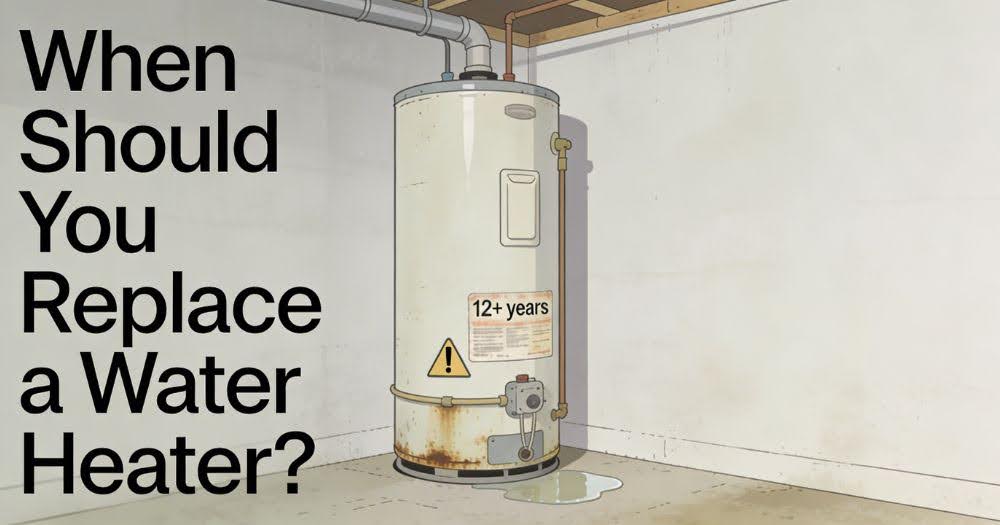
Tank based water heaters typically last between 8 and 12 years on average. With consistent maintenance and a bit of good fortune, some can push toward the 15-year mark. However, most manufacturers design these systems with a 10-year service life in mind. This is why many warranties are written for exactly that period. After 10 years, you’re essentially on borrowed time, even if the unit continues to function.
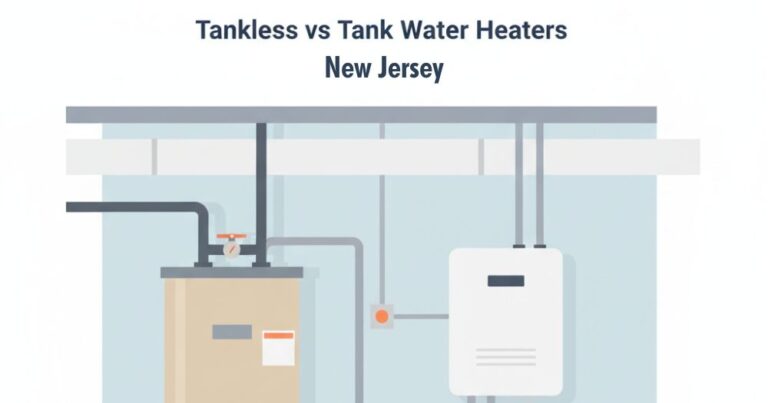
Tankless Water Heaters
Tankless water heaters are often marketed as systems that last far longer than standard tanks, but in real‑world conditions their life expectancy is usually closer to that of a traditional unit. In most homes, a tankless system can realistically be expected to last around 10 to 12 years when it is installed correctly and maintained on schedule.
The key difference with tankless is maintenance. These units use a heat exchanger that must be professionally cleaned once a year to remove scale and mineral buildup, especially in homes with hard water. Skipping this annual service can shorten the life of a tankless water heater and lead to expensive repairs, which is why many plumbers recommend budgeting for yearly maintenance as part of the overall ownership cost. At Doctor Water Heater, this professional annual cleaning and maintenance for a tankless unit typically costs about $299 per year in New Jersey.
Factors That Influence Your Water Heater’s Actual Lifespan
Water quality matters enormously. Hard water containing high levels of calcium and magnesium causes mineral buildup that accelerates deterioration. If you live in an area with hard water, expect your water heater to age faster than the average timeline. This buildup forms a crust at the bottom of the tank that insulates the water from the heat source, forcing your system to work harder and wear out faster. Regular annual flushing and draining can help counteract this issue significantly. When you flush a water heater regularly, you remove the sediment that would otherwise harden and damage your unit. This single maintenance task can extend your water heater’s life by several years.
Installation quality also plays a critical role. A properly installed unit in a well-ventilated area will outlast one that was hastily set up. Water heaters need proper ventilation to function safely and efficiently. Finally, usage patterns and household demand affect longevity. The more hot water your household uses, the harder your water heater works and the faster its components wear out. A family of six using hot water constantly puts much more strain on a unit than a couple living in a small apartment.
The Critical Age Threshold: What Happens at 10 Years
Here’s what most plumbing professionals agree on: once your water heater reaches 10 years old, you should start seriously monitoring its condition and planning for replacement.
This isn’t arbitrary guidance. At the 10-year mark, several important things begin happening inside your tank simultaneously. Corrosion accelerates as the protective layer within the tank degrades. Internal components wear out from years of thermal cycling. The sacrificial anode rod, which protects the tank from rust by attracting corrosive compounds to itself instead of the tank walls, becomes severely depleted or fully depleted.
Even if your water heater seems to be working fine at this age, the internal deterioration is advancing. You might have another year or two of reliable service, or the unit could fail catastrophically next month. This uncertainty is why the 10-year mark is so important.
If your water heater is between 10 and 12 years old and still operating without problems, you’re in a gray area. Many homeowners continue running their units at this age without incident. But this is also when unexpected failures become increasingly likely. If you’re in this age range, pay close attention to any warning signs and be ready to act quickly if they appear.
Once your water heater reaches 13 years old or beyond, replacement becomes strongly recommended, even if it’s not currently showing obvious problems. The risk of catastrophic failure increases significantly at this age. A sudden tank rupture or major leak isn’t uncommon, and the water damage to your home could cost thousands of dollars to repair. Many experts and home inspectors now recommend that homeowners replace water heaters that are 13 years or older regardless of current condition, simply because the risk of failure becomes unacceptable.
Seven Warning Signs Your Water Heater Needs Replacement
Age alone shouldn’t be your only decision factor. Watch for these specific warning signs that indicate replacement is needed, regardless of how old your unit is.
1. Visible Rust and Corrosion
Rust appearing on the tank exterior, around pipe connections, or at valve points tells you internal corrosion is occurring. Once rust takes hold, it’s only a matter of time before it eats through the tank material itself. There’s no repair for advanced corrosion and rust. If you see rust, especially red or brown rust stains, replacement is your only option. Attempting to patch or repair rust spots is like putting a band-aid on a cancer. The rust will continue to spread internally, and you’ll end up with a failure shortly after spending repair money.
2. Water Leaking From the Tank
Any leak coming from the tank itself signals that replacement is necessary. You may be able to fix leaks from pipe connections or valves, but a leak from the tank body means the structural integrity is compromised. Even a small leak will worsen over time and can cause serious water damage to your home.
There’s an important distinction here. Leaks from the drain valve at the bottom are usually fixable, as is water dripping from pipe connections at the top. But if water is pooling directly under the tank or seeping from the sidewalls or bottom seams, that’s the tank itself failing. At that point, replacement is your only option.
If you’re not sure where the leak is coming from, our detailed guide on how to fix a leaking water heater explains the diagnostic process and repair options in depth. Understanding whether you’re dealing with a connection issue or a tank failure is the first step in deciding whether to repair or replace.
3. Discolored or Rusty Water
Brown, rusty, or sediment-filled water coming from your taps is a clear sign of internal tank corrosion. Start by draining several buckets of hot water. If the water remains discolored after the third bucket, the problem is definitely in your water heater tank, not your home’s piping. This is a sign that replacement is approaching soon.
You can also check our article on why your hot water might smell like sulfur or appear discolored to rule out other causes. Some smells and discoloration can be addressed through other methods, but rust-colored water usually indicates tank deterioration that requires replacement.
4. Strange Noises Coming From the Tank
Banging, rumbling, popping, gurgling, or hissing sounds from your water heater indicate sediment buildup at the bottom of the tank. As sediment hardens over time, it creates an insulating layer between the heating element and the water. Your heater has to work harder and longer to heat water, consuming more energy and wearing out faster. The noises are actually the hardened sediment moving and cracking as the tank heats and cools.
While you might temporarily reduce this noise by flushing the tank, if the sediment has already hardened significantly, a flush may not solve the problem. The more your water heater makes noise, the more heavily sediment has accumulated. This is especially problematic because hardened sediment causes the metal to weaken and become brittle, accelerating the formation of cracks and leaks. Learn more about this issue in our comprehensive guide on how to flush and drain a water heater.
Once your water heater is making these sounds regularly, replacement is likely within a year or two. You can try one flush to see if it helps, but if the noises return or persist, don’t delay in planning replacement. Check out our article on water heater making noise for detailed information on what causes these sounds and what they mean for your unit’s future.
5. Insufficient or Inconsistent Hot Water
If your household is running out of hot water faster than it used to, or if the temperature is fluctuating inconsistently, your water heater is struggling. This could be due to sediment buildup, a failing heating element, or simply wear and tear on the system over years of service. When a water heater can no longer meet your household’s hot water demands, replacement is the logical solution.
Sometimes the issue isn’t your water heater’s ability to produce hot water but how quickly it delivers it or how long heating takes. If you’re experiencing long waits before hot water arrives at your tap, our article on how long a water heater takes to heat up explores the causes and solutions. However, if hot water takes longer to arrive AND you’re running out of it faster, that’s a clear sign of decline.
6. Recurring Repairs and High Repair Costs
If you’re constantly calling a plumber to fix your water heater, it’s a sign the unit is in decline. Here’s a useful rule of thumb: if a repair costs more than $450 on a water heater that’s already 5 or more years old, seriously consider replacement instead.
Calculate your repair costs over the past year or two. If you’re spending several hundred dollars annually on fixes, those costs will quickly add up to the price of a new unit. A new water heater eliminates these ongoing expenses and gives you peace of mind. For detailed pricing information, check out our complete breakdown of water heater replacement costs to understand what you can expect to invest.
Professional repairs versus DIY can also be a consideration. If you’re wondering whether you can replace your water heater yourself or if you should call a professional plumber, that’s an important decision. Our guide on whether you can replace a water heater yourself or should call a plumber covers the pros and cons of each approach, though we generally recommend professional installation for safety and warranty reasons.
7. Visible Cracks or Leaks at Welds and Seams
The weakest points on any water heater tank are the welded joints and seams. Due to constant expansion and contraction from heating and cooling cycles, these areas develop stress cracks over time. Once cracks appear, they will only expand. There’s no reliable way to patch a tank crack permanently. Any attempted repair is temporary at best.
The Case for Proactive Replacement Before Failure
You might be wondering: should I really replace my water heater before it fails? Can’t I just wait until it breaks?
The answer is nuanced, but in most cases, proactive replacement is the smarter choice. Here’s why the experts recommend it.
Avoid Emergency Situations
When a water heater fails without warning, you’re forced into an emergency replacement. You don’t have time to research options, compare prices, or schedule installation at a convenient time. You might end up paying premium emergency rates and settling for whatever model is available, not what’s best for your home. Emergency plumbing service calls often cost 50 to 100 percent more than scheduled service.
Prevent Catastrophic Water Damage
A catastrophic water heater failure, especially with an older unit, can dump dozens of gallons of water into your home rapidly. If your water heater is in a basement, crawlspace, or near finished living areas, this damage could cost thousands to repair. Replacing the unit before it fails is cheap insurance against this disaster.
One homeowner shared on a forum that ignoring replacement recommendations cost her hardwood floors, carpet, and extensive water damage when her 17-year-old heater failed in the middle of the night. The replacement cost $1,500, but the water damage repairs exceeded $8,000. Many similar stories exist across homeowner forums and plumbing company websites.
Save on Energy Costs
Old water heaters are significantly less efficient than newer models. If you notice your utility bills creeping upward without explanation, an aging water heater could be the culprit. A new water heater, especially a high-efficiency or tankless model, can reduce your energy consumption by 20 to 50 percent.
In many cases, the energy savings pay for the replacement within a few years. Federal tax credits and local utility rebates may also be available for efficient models. It’s worth checking what incentives exist in your area before making a replacement decision.
Enjoy Better Performance
Modern water heaters deliver faster, more consistent hot water. If you’ve been tolerating lukewarm showers or running out of hot water during back-to-back showers, upgrading could significantly improve your daily comfort. Newer units also tend to be quieter and more reliable. If you want to understand how quickly a new unit heats water, our article on how long a water heater takes to heat up provides detailed timelines for different types.
Peace of Mind
Simply knowing your water heater is new and reliable is worth something. You won’t spend years worried about when it might fail. You can schedule replacement at your convenience rather than having it forced upon you by an emergency.
Special Consideration: Your Water Heater’s Location Matters
Where your water heater is installed affects how urgently you should replace it. If your unit is in a garage or unconditioned crawlspace, a leak is relatively minor and contained. But if it’s in your basement near finished living areas, on a first floor, or in a condo where a leak could damage a neighbor’s property, the stakes are much higher.
In these high-risk locations, many experts recommend replacement at 10 years old rather than waiting until 12 to 13. The potential damage from a failure simply isn’t worth the money saved by delaying replacement.
Condominiums deserve special mention. Many condo associations now require water heater replacement at 10 years, and some upscale developments mandate replacement at just 8 years. This is because a single failure can affect multiple units and create expensive disputes between neighbors. Check your condo association documents for any requirements.
The Repair versus Replace Decision Framework
So when should you repair your water heater instead of replacing it? Generally, follow these guidelines:
If your unit is under 7 years old, a repair almost always makes economic sense. You have many years of expected life remaining, and the repair cost is usually justified.
Between 7 and 10 years, it depends on the repair cost and what’s failing. If the repair costs more than 25 to 30 percent of a new unit’s price, replacement might make more sense.
If it’s after 10 years, replacement is almost always the better choice. The unit is likely to need additional repairs soon anyway, and you’re approaching the end of its expected life.
Use this calculation: repair cost times expected remaining life in years, compared to replacement cost. If the repair cost is more than 50 percent of replacement cost, lean toward replacement. Is the unit over 10 years old? If yes, lean toward replacement. Are you seeing multiple warning signs, not just one? If yes, lean toward replacement. Would you need this repair done again in the next year or two? If yes, likely time to replace.
What About Before Selling Your Home?
If you’re planning to sell your house, should you replace an aging water heater? This depends on local real estate expectations and your unit’s actual condition. In many markets, a 10-plus-year-old water heater is expected to be replaced or disclosed. A home inspection might flag it as a concern, and buyers might ask for a discount to cover replacement costs.
If your water heater is functional but aging, replacing it before listing can be a smart investment. It removes an objection during negotiation and shows buyers you’ve maintained the home properly. It’s also easier to schedule replacement on your timeline rather than during a rushed sale closing.
How to Find Out Your Water Heater’s Actual Age
Before you can make an informed decision, you need to know how old your unit actually is. Look at the manufacturer’s label or rating plate, usually found on the upper half of the tank. Find the serial number and note the brand name.
The first character or two of the serial number typically indicates the manufacturing month and year, but the format varies by manufacturer. You can search online for your specific brand water heater serial number decoder to find the exact age.
Record this information somewhere safe, as you’ll need it when planning replacement or communicating with plumbers.
The Timeline for Replacement: How Long Does It Take?
Once you decide to replace your water heater, understanding the timeline helps with planning. Our comprehensive article on how long it takes to replace a water heater covers installation time, scheduling, and what to expect during the process. Most professional installations take anywhere from a few hours to a full day, depending on complexity and whether modifications to plumbing are needed.
The Bottom Line: Plan Ahead, Don’t React
Water heater replacement is one of those home maintenance decisions that feels like you might be throwing money away if you do it early. But the reality is that an old water heater is a ticking time bomb. The question isn’t really if it will fail, but when.
If your water heater is over 10 years old, start planning. Research options, get quotes, and understand what replacement involves. If it’s over 13 years old, start shopping now. And if it’s showing any of the warning signs listed above, regardless of age, call a professional plumber immediately to assess the situation.
Replacing your water heater proactively, before it fails, saves you from emergency situations, protects your home from water damage, and often pays for itself through energy savings. It’s an investment in your home’s comfort and safety that almost always makes good financial sense.
Ready to understand the replacement process better?
Our guides on water heater replacement costs and what to expect from professional installation can help you plan ahead. The more prepared you are, the smoother your replacement experience will be.