
Quick Answer:
Tankless is better IF: You have the budget ($3,850-$6,495 installed in NJ), need unlimited hot water, and plan to stay in your home 10+ years.
Tank is better IF: You want lower upfront cost ($1,200-$1,900), have average hot water needs, and prefer simplicity.
For most New Jersey homeowners, a traditional tank is still the right choice. But the gap is closing.
How a Tankless Water Heater Actually Works
A tankless water heater doesn’t store hot water. Instead, it heats water on-demand as you use it. You turn on a hot water tap, cold water flows into the unit, a powerful heating element or gas burner instantly brings it to temperature, and hot water comes out. It’s like having an unlimited supply because the heater keeps producing hot water as long as you need it.
Here’s the key difference from a tank: a traditional water heater keeps 40-50 gallons of water perpetually hot, even when you’re asleep or at work. It’s always maintaining temperature, always using energy. A tankless heater only runs when you actually need hot water. That’s where the energy savings come from.
Gas tankless units heat water by running it past a powerful gas burner. Electric tankless units use high-powered heating elements. Both work instantly—the delay between turning on the tap and getting hot water is measured in seconds, not minutes.
Tank Water Heater: The Traditional Choice
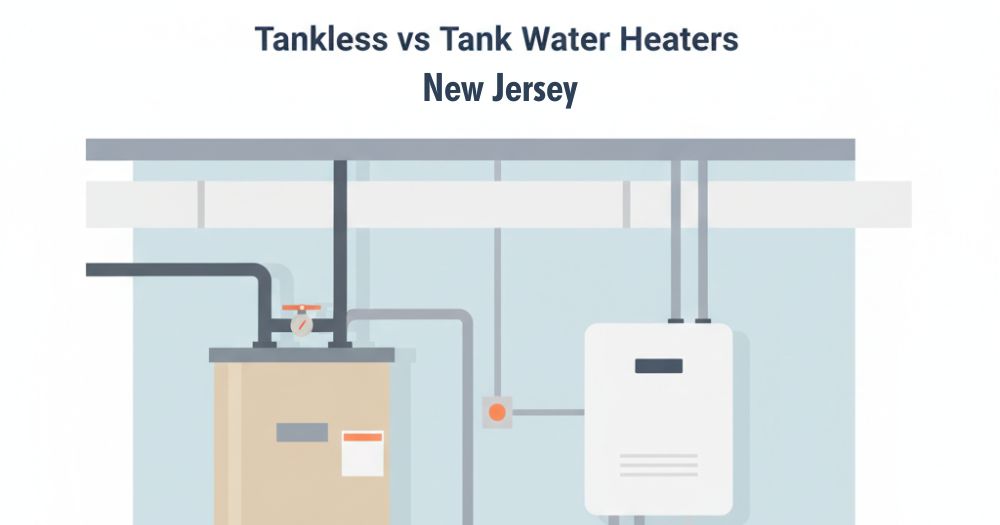
A tank water heater stores 40-50 gallons of hot water in an insulated tank. A burner or heating element maintains the temperature constantly. When you use hot water, cold water enters to refill the tank, and the heater begins reheating.
Recovery time matters with tanks. Once you drain the hot water (a long shower uses 15-25 gallons), the heater needs 30-45 minutes (gas) or 60-90 minutes (electric) to reheat a full tank. If your family uses multiple showers back-to-back, you run out of hot water and wait for recovery.
Tank heaters are simple. They have fewer components, fewer things can go wrong, and they’re repairable. When something fails, you replace a heating element or thermostat for $200-400. You’re not replacing the entire unit.
The Real Cost Comparison for NJ Homeowners
Here’s where people get confused. Tankless costs more upfront, but saves money on energy. The question is whether the energy savings justify the higher price.
Installation cost in New Jersey:
Tank water heater: $1,200-$1,900 installed (gas) or $1,000-$1,400 (electric)
Tankless water heater: $3,850-$6,495 installed (gas) or $3,500-$5,000+ (electric with panel upgrade)
That’s a $2,000-$4,500 difference upfront. That’s substantial.
Energy savings:
A tankless unit typically saves $100-$200 per year on energy costs compared to a tank. Some estimates go higher (up to $300/year), but $150/year is realistic for most NJ homes.
At $150/year savings, your tankless unit needs 13-30 years to pay for itself through energy savings alone. That’s longer than most tankless units last (typically 15-20 years for quality units).
However, tankless units DO last significantly longer than tanks (which fail at 10-15 years). A tankless that lasts 20 years versus a tank that lasts 12 years means you replace your tank 1-2 more times. Each replacement is $1,500-$2,500. Across 30 years, that adds up to real savings.
The real financial picture:
Over 30 years in your home: Tankless saves money despite higher upfront cost. Over 10 years: Tank is cheaper. If you’re not staying in your home long-term, tank makes financial sense.
Performance Differences: When It Actually Matters
The biggest practical difference between tankless and tank is what happens during heavy water use.
Imagine a family of four on a busy morning. Dad showers (15 gallons), then mom showers (20 gallons), then kids shower. With a 40-gallon tank, someone’s getting a cold shower or waiting.
With tankless? Everyone gets hot water whenever they want. The heater produces as much as you need, simultaneously if multiple people use hot water.
For families that value this—large families, homes with multiple bathrooms, people who take long showers—tankless changes daily life noticeably. For average users, the difference is minimal.
Winter matters here too. In New Jersey’s cold months, incoming water is 35-45°F. Tankless units work fine in winter, but they take slightly longer to heat water (a few extra seconds). Tanks are unaffected by outdoor temperature.
Maintenance: Tankless Requires More Care
Tank water heaters need annual flushing to remove sediment. That’s it. Simple maintenance.
Tankless units need more attention. They require descaling every 1-2 years if you have hard water. Hard water minerals build up inside the heating exchanger, reducing efficiency. Descaling costs $200-400 professionally. In New Jersey, where water hardness is moderate to high in many areas, this is an actual maintenance burden.
Tankless units also need professional inspection more frequently. Any blockage or malfunction is harder to diagnose than a tank issue.
For someone who maintains appliances proactively, this is manageable. For someone who ignores maintenance, tankless becomes a problem.
The Winter Consideration for NJ Homeowners
Here’s something most articles miss: winter affects these systems differently.
Tank heaters struggle in winter because they work harder but don’t perform better. Your heater must heat 35°F water to 120°F, which takes longer and uses more energy. But you still have the same 40 gallons available.
Tankless heaters have a different winter issue. Cold incoming water requires the heater to work at maximum capacity longer. If multiple people use hot water simultaneously in winter, a mid-range tankless unit might not keep up. You need a higher-capacity unit ($1,000+ more expensive) for winter comfort.
This is why NJ homeowners should size tankless units conservatively. What works in summer might struggle on a cold January morning when everyone showers before work.
New Jersey Specific: Water Hardness Matters
New Jersey’s water hardness varies by region, but much of the state has moderate to high hard water. This affects both systems, but especially tankless.
Hard water means mineral buildup. In a tank, sediment settles at the bottom; you flush it out annually. In a tankless unit, minerals coat the heating exchanger; you need chemical descaling.
If you already have a water softener, tankless maintenance becomes much easier. Without one, tankless maintenance gets annoying in NJ.
This is a reason many NJ homeowners stick with tanks despite tankless benefits. Maintenance simplicity matters.
Installation Complexity: Tank Wins
Installing a tank water heater is straightforward. You remove the old one, install the new one, reconnect the same pipes, and you’re done. 2-4 hours, usually in one day.
Installing tankless is complex. You need new venting (if gas), potentially new gas lines, possibly electrical upgrades, new water line configuration. Most tankless installations take 6-8 hours or require 2 days. In New Jersey, this adds to labor cost.
If your home already has ideal conditions for tankless (right venting, adequate gas supply, proper electrical capacity), installation is simpler. If you need to modify infrastructure, costs climb quickly.
Space: Tankless Wins Here
A tankless unit is about the size of a small medicine cabinet. A tank is a 4-foot-tall cylinder taking up floor space.
If you have a tiny utility closet or limited space, tankless is the obvious choice. Otherwise, this is a minor consideration.
The Real Question: What Do You Actually Need?
Stop thinking about tankless versus tank. Instead, answer this: What’s your hot water situation?
Do you run out of hot water regularly? Tank is undersized. Upgrade to a larger tank or switch to tankless. Tankless solves the problem permanently.
Does your hot water take forever to arrive at distant faucets? This is a plumbing issue, not a heater issue. Neither tankless nor a new tank fixes this.
Do you want to reduce energy bills? Tankless helps, but so does insulating pipes, lowering thermostat to 120°F, or fixing leaks. Energy efficiency starts with the whole system, not just the heater.
Is your heater over 10 years old? Replace it now before winter. Upgrading to tankless is optional; but replacing an aging tank is mandatory. Choose based on budget and needs, not marketing hype.
Are you staying in your home 15+ years? Tankless makes financial sense. Less than that: tank is smarter.
The Honest Assessment for Most NJ Homeowners
Most New Jersey homeowners should stick with a traditional tank water heater. Here’s why:
Tank heaters work. You have hot water. Maintenance is simple. Cost is reasonable. If something breaks, it’s fixable. They last 12-15 years, which aligns with how long people stay in homes.
Tankless is better for specific situations: large families, homes with multiple bathrooms and heavy water use, people committed to maintenance, those staying long-term. But it’s not universally better.
The marketing around tankless is strong. Unlimited hot water sounds amazing. But most people use 40 gallons of hot water per day, and a tank provides that fine. The unlimited feature goes unused.
Where tankless truly shines is homes that legitimately run out of hot water regularly. If that’s you, tankless solves a real problem. Otherwise, you’re paying premium prices for a feature you don’t need.
Hybrid Option: Consider Heat Pump Water Heaters
Here’s something worth mentioning: heat pump water heaters exist. They’re a middle ground—they look like tanks but operate more efficiently than traditional tanks and less expensively than tankless.
They cost $1,600-$3,000 installed and save $200-300/year on energy. They don’t solve the “running out of hot water” problem but improve efficiency significantly.
For many NJ homeowners, a heat pump water heater is the sweet spot: better efficiency than tank, lower cost than tankless, simpler than tankless.
Making Your Decision
Choose tank if: You want lower cost, simple maintenance, proven reliability, don’t run out of hot water.
Choose tankless if: You run out of hot water regularly, have the budget, plan to stay 15+ years, don’t mind maintenance.
Consider heat pump if: You want efficiency improvement without full tankless commitment.
Don’t choose based on trend or marketing. Choose based on your actual hot water needs and financial situation. For most NJ homeowners, a traditional tank still makes the most sense.
Related Articles
- Water Heater Replacement Cost in 2026 — Detailed tankless and tank pricing
- How Long Does It Take to Replace a Water Heater? — Timeline differences between types
- When Should You Replace a Water Heater? — Signs your current heater is failing
- Can You Replace a Water Heater Yourself? — DIY considerations for different types
Professional Guidance for Your Home
Choosing between tankless and tank depends on your specific situation—home age, water hardness, usage patterns, budget, and timeline. A professional assessment beats online articles.
Doctor Water Heater can evaluate your home, explain the pros and cons of each option for your situation, and recommend what actually makes sense. We’ll show you real numbers for your home, not generic estimates.
Get Professional Recommendation Today
Don’t let marketing decide. Get expert guidance based on your actual needs.
Water heater choice depends on household size, usage patterns, budget, and long-term plans. Both tankless and traditional tanks are reliable options when properly installed and maintained.