
You walk down to your basement and see water dripping from your boiler. Your heart sinks. Is my boiler broken? Do I need a new one? Is this an emergency?
Take a breath.
A leaking relief valve is stressful, but here’s the truth: in 9 out of 10 cases, it’s fixable and often the valve itself isn’t even the problem. The leak is usually a symptom of something simpler happening in your boiler system. Understanding what’s causing it is the first step to fixing it fast.
Let’s figure out what’s going on with your boiler and what you need to do right now.
What Is a Boiler Relief Valve and Why Does It Exist?
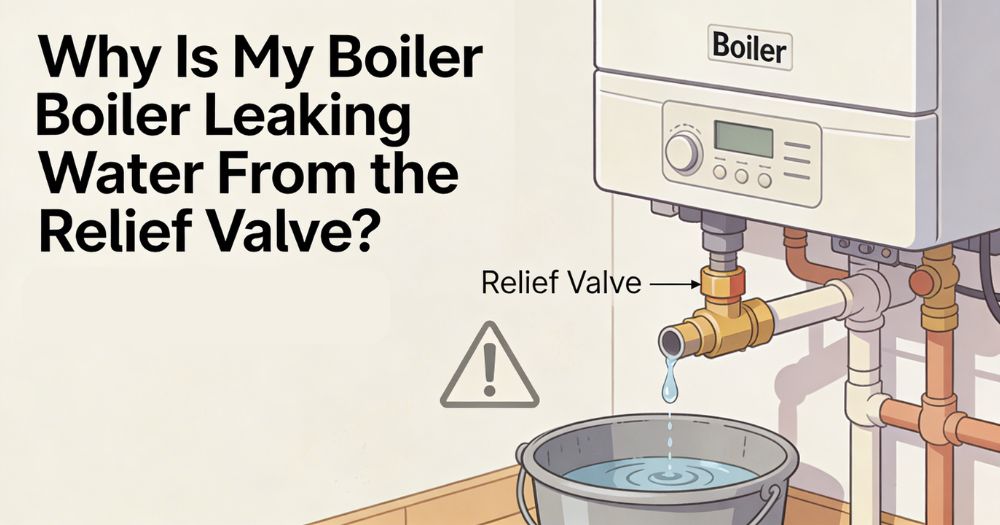
A relief valve is one of the most important safety devices on your boiler. Here’s how it works:
When your boiler heats water, the water expands. In a sealed boiler system, that expansion creates pressure. If pressure builds too high, the relief valve automatically opens to release excess water and protect the boiler from damage or rupture. The valve is set to open at approximately 30 PSI (pounds per square inch), while normal operating pressure is around 12–15 PSI when the boiler is cold.
This is important: The relief valve is supposed to leak if pressure gets too high—that’s its job. It’s protecting your boiler.
But here’s the key: if your relief valve is leaking constantly, something else is causing excessive pressure. The valve isn’t broken; it’s responding to a problem in the system. The leak is a symptom, not the disease.
That’s good news, because finding and fixing the underlying cause usually stops the leak for good.
Why Is My Boiler Relief Valve Leaking? 5 Common Causes
Let me walk through the five most common causes of relief valve leaks. For each one, I’ll explain what’s happening, how to spot it, and what it means for your boiler.
1. Waterlogged Expansion Tank (Most Common)
What’s happening:
Your boiler has a small tank (usually 2–12 gallons) called an expansion tank, typically mounted near or below the boiler. This tank is divided by a rubber diaphragm: one side holds air, the other side holds water. When your boiler heats water and it expands, the expansion tank absorbs that extra water, keeping pressure under control.
Over time—typically 5–10 years—that rubber diaphragm can fail. When it does, the tank fills with water instead of maintaining the air cushion. Now the system can’t absorb expansion, so pressure keeps climbing, and your relief valve keeps opening to release water.
How to check:
Find the expansion tank (usually a small cylindrical tank near your boiler). Tap it gently with a hammer or screwdriver handle.
- Top half should sound hollow/metallic (that’s the air side)
- Bottom half should sound full/dull (that’s the water side)
- If the entire tank sounds solid and full = waterlogged expansion tank
Is it dangerous?
Yes. Constant relief valve opening stresses other components. The repeated pressure cycling can damage valves, seals, and piping.
Repair cost:
$300–$600 (expansion tank replacement). This is the most common fix we perform for relief valve leaks.
2. System Overfilled With Water
What’s happening:
Boiler systems are sealed loops. Water enters only through a fill valve, which is supposed to open only when pressure drops below normal (around 12 PSI). If that fill valve gets stuck open, or if someone fills the system and leaves the valve on, the boiler becomes overfilled.
Overfilled systems have high static pressure even when cold—and as the boiler heats, pressure climbs even higher, triggering the relief valve to open and release water.
How to check:
Look at your pressure gauge when the boiler is completely cold (hasn’t been heating for at least an hour).
- Normal pressure = 12–15 PSI
- If it reads 20+ PSI when cold = system is overfilled
Is it dangerous?
Not immediately, but prolonged high pressure stresses all system components.
Repair cost:
$0 if you know how to drain excess water yourself. $150–$300 if a technician does it.
3. Faulty Pressure Reducing Valve or Auto-Fill Valve
What’s happening:
The pressure reducing valve (sometimes called an auto-fill valve or fill valve) is supposed to let water into the system only when pressure drops. It’s supposed to stop once pressure reaches normal.
If this valve is stuck, defective, or adjusted too high, it continuously feeds water into the boiler even when pressure is already adequate. Result: pressure keeps climbing, and the relief valve keeps opening.
How to check:
Watch your pressure gauge over a 15-minute period while the boiler isn’t actively heating.
- Normal = pressure stays stable (12–15 PSI)
- Problem = pressure continuously climbs, even though no heating is happening
Is it dangerous?
Yes. Constant high pressure damages seals, valves, and piping over time.
Repair cost:
$250–$500 (valve replacement or adjustment).
4. Boiler Running Too Hot
What’s happening:
Most residential boilers operate at around 180°F. But sometimes a boiler is set higher—either due to user adjustment, a faulty thermostat, or equipment malfunction. Hot water expands more than cool water, creating higher system pressure.
Higher pressure = relief valve opens more frequently to relieve that extra pressure.
How to check:
Feel the hot water pipe leaving your boiler. Is it dangerously hot (more than you can hold for 3 seconds)? That suggests the boiler is running hotter than normal. Check your thermostat (called an “aquastat” on older systems)—is it set above 180°F?
Is it dangerous?
Yes. Excessive boiler temperature can damage internal components and seals.
Repair cost:
Free if you adjust the thermostat yourself. $100–$200 if a technician does it.
5. Relief Valve Itself Is Worn or Defective
What’s happening:
Relief valves are mechanical devices with springs, seals, and moving parts. Over 10–15 years, these components wear. Sediment from old piping can also clog the valve, preventing it from sealing properly. A worn valve may open at lower pressures than it’s supposed to, causing constant dripping even when pressure is normal.
How to check:
Your pressure gauge reads normal (12–20 PSI when cold), but the relief valve still drips constantly = the valve itself is likely failing.
Is it dangerous?
Not immediately dangerous, but a failing relief valve can’t protect you if pressure truly spikes. It should be replaced.
Repair cost:
$150–$350 (relief valve replacement).
Is a Leaking Relief Valve an Emergency?
Here’s the honest answer: a leaking relief valve is usually NOT a catastrophic emergency, but it does need professional attention within 1–2 days.
In most cases, your boiler is protecting itself. The relief valve is doing exactly what it’s supposed to do—releasing excess pressure before it damages the system.
However, there are exceptions. Call for same-day emergency service if:
- The relief valve is leaking heavily (a steady stream, not just a drip)
- Water is pooling on the floor in significant amounts
- Your boiler is shutting off repeatedly or cycling on/off constantly
- The pressure gauge reads above 30 PSI
- You smell gas or notice corrosion around the boiler
You can wait 1–2 days if:
- The valve is just dripping (a few drops per minute)
- Pressure is in the normal range or only slightly elevated
- No significant water pooling
- Your boiler is still heating normally
When in doubt, call. Doctor Water Heater offers 24/7 emergency boiler service, and we can help you assess whether it needs immediate attention or can wait a day or two.
How to Fix Your Leaking Relief Valve: Next Steps
Here’s a practical action plan to get this sorted quickly.
Step 1: Stay Calm
You now know that relief valve leaks are usually caused by one of five fixable issues. In almost all cases, you’re looking at a repair—not a boiler replacement.
Step 2: Check the Pressure Gauge
If your boiler has a visible pressure gauge, note the reading when the boiler is cold. If it reads 20+ PSI, your system is overfilled (easiest and cheapest fix). If it’s normal (12–15 PSI) but the valve still leaks, the problem is the expansion tank, fill valve, or the relief valve itself.
Step 3: Inspect the Expansion Tank
Locate the small tank near your boiler. Tap the top and bottom. If the entire tank sounds solid and waterlogged, that’s likely your problem.
Step 4: Check the Fill Loop Valves
Look for a braided hose (usually near the boiler) with two small valves at each end. Both valves should be closed unless you’re actively filling the system. If they’re open, close them—water may be continuously entering the system.
Step 5: Call a Professional
You’ve now likely identified the cause. A technician can confirm your diagnosis and fix it quickly. Most relief valve repairs take 1–2 hours and cost between $150–$600 depending on the cause.
Timeline: Don’t wait weeks. Call within 1–2 days to prevent water damage to your basement and unnecessary wear on boiler components.
Got a Leaking Boiler Relief Valve? We Can Help
A leaking relief valve feels like an emergency, but it usually isn’t catastrophic. Most of the time, the fix is straightforward: replace the expansion tank, drain excess water, adjust a valve, or replace the relief valve itself. Doctor Water Heater has handled thousands of relief valve leaks in Morris County. We know what’s causing yours, and we can fix it fast, often same-day.
We offer 24/7 emergency boiler service. If your relief valve is leaking, don’t wait for water damage to spread or the problem to worsen. Call today and let us diagnose and fix it.
Call for emergency service:
If you do end up needing a replacement boiler down the road, check out our Boiler Installation page to see your options. But first, let’s get this leak stopped.
Doctor Water Heater:
Licensed & Insured | Morris County’s Trusted Boiler Experts | 24/7 Emergency Service Available