
Nobody wants to be the second shower of the morning and find out the hard way that there’s no hot water left. If this keeps happening, your water heater is trying to tell you something.
The good news: the causes are limited, and most are easy to diagnose once you know what to look for. Here’s why your hot water run out so fast and what actually fixes each cause.
The Short Answer
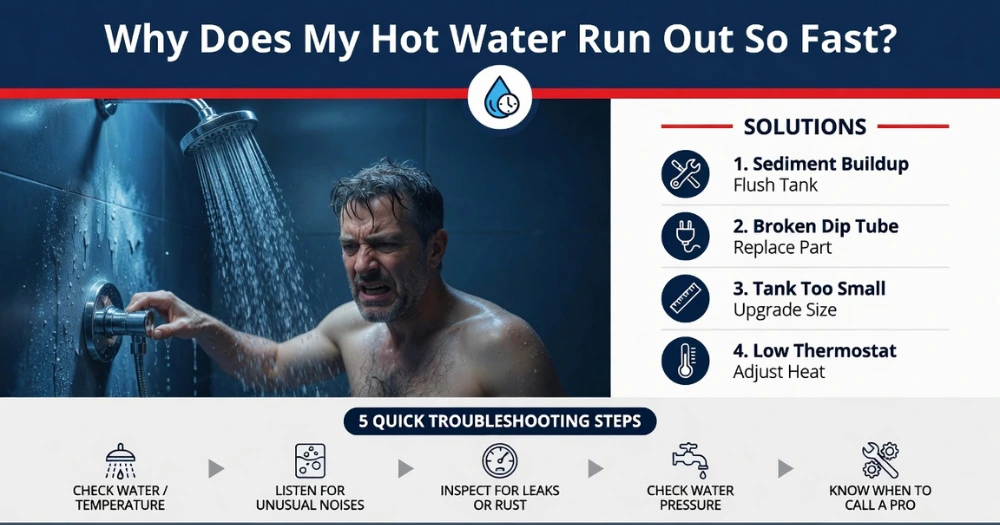
In most homes, running out of hot water quickly comes down to one of five things: sediment buildup, a broken dip tube, an undersized tank, a thermostat set too low, or a failing heating element. Tank age and internal corrosion can also play a role, especially in units past the 10-year mark.
Below is a quick reference, then a closer look at each cause.
|
Symptom |
Likely Cause |
Typical Fix |
|
Hot water fades gradually over months |
Sediment buildup |
Flush the tank |
|
Water is lukewarm, never fully hot |
Broken dip tube |
Replace the dip tube |
|
Runs out fast during high-usage periods |
Tank too small |
Upsize or go tankless |
|
Water never gets hot enough |
Thermostat set low |
Adjust thermostat |
|
Hot water cuts out halfway through a shower |
Failed heating element (electric) |
Replace the element |
|
Rusty water, rumbling, tank over 10 years old |
Corrosion or age |
Inspection, likely replacement |
Sediment Buildup
This is the most common cause, especially if you have hard water. Calcium and magnesium settle out of the water as it heats, and over years that mineral layer builds up at the bottom of the tank.
A 50-gallon tank with 10 gallons of sediment sitting at the bottom is really only working with 40 gallons. You lose usable capacity without any obvious sign until the hot water starts running out sooner than it used to.
Signs of sediment buildup:
- Hot water supply has been shrinking gradually, not suddenly
- Rumbling, popping, or crackling sounds from the tank while it heats
- Longer wait times for water to heat back up between uses
- It’s been more than a year since the tank was last flushed
The fix: flush the tank. We’ve got a full walkthrough in our guide to flushing and draining a water heater. Annual flushing is the standard recommendation, though homes with hard water may benefit from doing it every 8 to 9 months.
Broken Dip Tube
The dip tube is a plastic tube inside the tank that pushes incoming cold water down to the bottom, so it doesn’t mix with the hot water sitting at the top of the tank waiting to be drawn off. When it cracks or breaks, cold water dumps in near the top of the tank instead, mixing with your hot water supply and cutting the usable temperature short.
This can happen on gas or electric units, and it’s one of the more overlooked causes because the symptom (lukewarm water that never gets properly hot) looks a lot like a thermostat problem at first glance.
The fix: the dip tube has to be replaced. This isn’t usually a DIY-friendly repair since it means draining the tank and disconnecting the cold water inlet fitting.
Your Water Heater Is Too Small
If your household usage has grown, more people, more showers, a new dishwasher, but the water heater hasn’t changed, the tank may simply be undersized for current demand.
Sizing is based on what’s called a First Hour Rating (FHR), the amount of hot water a tank can deliver in one hour starting full. According to the Department of Energy, sizing should match your household’s peak hour demand, meaning the busiest 60-minute stretch of hot water use in your home, not your total daily use.
As a rough starting point:
- 1 to 2 people: 30 to 40 gallons
- 3 to 4 people: 40 to 50 gallons
- 5 or more people: 50 to 80 gallons
The fix: upgrade to a larger tank, or consider switching to a tankless system, which heats water on demand instead of storing a fixed supply. Tankless units solve the “too small” problem entirely, though the upfront cost is higher than a comparable tank replacement.
Thermostat Set Too Low
Sometimes the fix really is this simple. If the thermostat has drifted down, from a reset, a DIY adjustment, or just age, the tank won’t heat water as high as it should.
The Consumer Product Safety Commission recommends a setting of 120°F, which balances comfort with scald protection. If your unit is set well below that, raising it slightly can solve the problem outright. Avoid going above 120 to 125°F unless a household member has a medical need for hotter water, since higher settings increase scald risk significantly.
The fix: adjust the thermostat in small increments and wait about an hour between changes to see the effect, rather than cranking it up all at once.
Faulty Heating Element (Electric Models)
Electric water heaters typically have two heating elements, one near the top of the tank and one near the bottom. If one fails, the other can still produce some hot water, but your usable supply is effectively cut in half.
This is one of the more common repairs on electric units and often shows up as hot water that starts strong, then disappears much sooner than it used to.
The fix: the failed element needs to be tested and replaced. This involves working with an energized electrical circuit near water, so it’s worth having a licensed technician handle it rather than guessing.
Water Heater Age
Tanks generally last 8 to 12 years. Past that point, efficiency drops and the tank becomes less able to hold heat effectively, even without an obvious failure. If your unit is approaching or past that range and hot water is running out faster than it used to, age itself may be the answer, not a single fixable part.
Our guide on when to replace a water heater walks through how to weigh a repair against a full replacement once a unit gets into that window.
Corrosion or Leaks
Internal tank corrosion reduces both capacity and heat retention, and it’s not always obvious until it’s advanced. Check for rust-colored water, a metallic smell, or puddles forming near the base of the unit.
A small leak might seem minor, but it usually points to a bigger problem developing inside the tank. If you notice any of these signs, it’s worth a look before it turns into water damage.
Tips to Make Your Hot Water Last Longer
A few habits can stretch your existing hot water supply without any repairs at all:
- Install low-flow showerheads to reduce hot water draw per minute
- Space out high-usage tasks, like running the shower and dishwasher back to back instead of at the same time
- Lower your washing machine’s temperature setting for loads that don’t need hot water
- Flush your tank annually to keep full capacity available
- Consider a tank booster if you’re consistently just short of enough hot water
Quick Troubleshooting Checklist
If your hot water is running out faster than expected, work through these in order:
- Check the thermostat setting
- Look for rust, corrosion, or puddling around the unit
- Listen for rumbling or popping sounds during heating
- Note the age of the unit; past 10 years, replacement may make more sense than repair
- If none of the above explain it, the issue may be a hidden one like a broken dip tube or a failed element
A Note From Experience
Not every “runs out fast” complaint is actually a water heater problem. We’ve been called out to homes where the real issue was a recirculation pump running constantly, or a mixing valve set incorrectly after a fixture upgrade, both of which mimic tank problems but have nothing to do with the tank itself. A quick diagnostic visit usually sorts out which category you’re actually in before any parts get replaced.
FAQ
Is it normal for hot water to run out faster in winter?
Yes. Incoming groundwater is colder in winter, so the tank has to work harder to reach the same output temperature, and recovery between uses takes longer. Our guide on how long a water heater takes to heat up covers this in more detail.
How often should I flush my water heater?
At least once a year for most households, more often if you have hard water.
When should I consider replacing instead of repairing?
If the unit is over 10 to 12 years old, leaking, corroded, or can’t keep up with your household’s demand even after basic troubleshooting, replacement is usually the more cost-effective route.
Do I need a tankless water heater to stop running out of hot water?
Not necessarily. A correctly sized tank can solve the problem for most households. Tankless is worth considering if your household usage is high and unpredictable, or if you’re already due for a replacement anyway.
If troubleshooting doesn’t turn up an obvious answer, or you’d rather have a professional pin it down the first time, contact us for a diagnosis.
Sources
- U.S. Consumer Product Safety Commission — Avoiding Tap Water Scalds
- ENERGY STAR (U.S. EPA / DOE) — Water Heater Key Product Criteria